 Link building
 Guest Posting
 Niche edits
 Profile backlinks
 Crowd links
 Submission links
 Contextual Backlinks
 White-label link building
 PBN Building
 Haro links
 Digital PR
 SEO
SEO
 SEO copywriting
 Google Indexing
 Quora links
 Add to catalogs
 AI SEO
 Reddit

In 2026, treating SEO as just another line item is a mistake. It’s a critical investment. The market’s more crowded than ever, your competitors are savvier, and Google’s algorithms keep raising the bar. That’s why the question, “how much does SEO cost in 2026,” is top of mind for any business owner focused on sustainable growth, not just luck.
The truth is, there’s no one-size-fits-all answer. Your final price tag hinges on your industry, how fierce the competition is, your growth targets, the size of your website, and how you choose to work. This guide will break down typical SEO prices in 2026, explain what goes into the cost, and help you figure out a realistic SEO budget that brings actual results, not just monthly reports.
Why SEO Pricing Is All Over the Map
You can look at two businesses in the same niche and see wildly different SEO services cost 2026. That’s because modern SEO isn’t one thing – it’s a bundle of micro-services. Different markets need different levels of effort. For one company, SEO might be a modest monthly fee. For another, it’s a major investment comparable to funding an entire marketing department.
What Drives the Price in 2026: Your Niche, Location, and Competition
In competitive industries, the easy wins are gone. You’re up against players who are already investing heavily in top-tier content, strategic links, and flawless site tech. The higher the stakes, the more time and money you need for in-depth research, planning, and execution.
Your location matters, too. Tackling markets like the USA, Canada, or Western Europe costs more. Why? Content creation is pricier, quality links command higher rates, and technical standards are stricter.
In regions like the CIS, budgets can be lower due to lower operational costs. But if you’re targeting multiple countries at once, the price jumps because you need tailored strategies for each search landscape.
Your business model also shapes the cost. For e-commerce, a big chunk of the budget goes to technical maintenance of massive product catalogs. In B2B, the investment shifts to creating deep, expert-level content. And if you need fast results? Be prepared to pay a premium for an accelerated pace, which requires a larger team and aggressive link-building.
In-House, Freelancer, or Agency: Why the Price Can Vary by 10x
In 2026, you’ve got three main paths, each with its own price point and trade-off:
- Building an In-House Team: Perfect for large companies that want total control and dedicated focus. But get ready for the full cost: salaries, benefits, software tools, and likely needing to pull in developers. It offers maximum control but is often the most expensive route.
- Hiring a Freelancer: A great fit for small businesses or specific, one-off projects. The catch? Your success hinges on one person’s bandwidth and skill set. If they get sick, go on vacation, or are juggling too many clients, your progress stalls. Depth of expertise can also be a limitation.
- Partnering with an Agency: You get a full team – strategists, content writers, link builders, analysts – without the HR overhead. The SEO cost per month is higher than a freelancer but usually less than a full-time team. Quality and scope vary widely, so the check can differ by 5-10x, but you’re paying for breadth and depth.
Why No Reputable Pro Will Give You a Firm Quote in 5 Minutes
If someone gives you a solid number after a quick chat, be wary. Serious SEO requires diagnosis. We need to look under the hood: your traffic history, who you’re up against, your site’s technical health, content quality, and your goals. Is this a site recovery project? A new market launch? A massive e-commerce catalog?
SEO in 2026 is deeply customized. A cookie-cutter price from a generic menu won’t cut it. An honest budget comes from a real analysis. That’s why we start with a free consultation – to understand your situation before talking numbers.
How to Pay for SEO: Picking the Right Model for Your Goals

Your goals define the best payment model. Need steady growth? A quick fix? A major one-time overhaul? Here’s how the models stack up.
Monthly Retainer: The Go-To for Predictable, Ongoing Growth
This is the most common setup. You pay a fixed average SEO cost each month for a package that covers strategy, content, links, technical tweaks, and reporting.
- Best for: Businesses that want a long-term partner and consistent, compounding growth.
- The Upside: Predictable budgeting and a team that manages the full SEO lifecycle.
- The Vibe: “Set it and forget it” (with good oversight, of course).
Hourly Rate: Maximum Flexibility for Specific Expertise
Need a seasoned expert to audit your site, plan your content quarter, or troubleshoot a tricky technical issue? Hourly is your friend.
- Best for: Businesses with an existing SEO foundation that need strategic guidance or specialized help.
- The Upside: You only pay for the time you need, and you can tap top-tier talent.
- The Catch: This isn’t for driving ongoing growth. It’s for solving specific problems.
Project-Based: A Fixed Scope for a Defined Outcome
Great for projects with a clear beginning and end. Think: a comprehensive technical audit, building a keyword strategy for a new site, or a one-time content blitz.
- Best for: Startups, new site launches, or businesses with a discrete, one-time need.
- The Upside: You know the exact SEO cost estimate and deliverable upfront.
- Important Note: SEO doesn’t stop after a project. To maintain results, you’ll usually need to transition to a retainer or plan follow-up projects.
Quick Comparison: Which Model Fits You?
| Model | Best For | Pros | Cons |
|---|---|---|---|
| Monthly Retainer | Long-term, stable growth | Full-service, predictable cost, compounding results | Not for quick, one-month wins |
| Hourly Rate | Targeted fixes & expert advice | Flexible, pay-as-you-go, access to specialists | No ongoing growth strategy |
| Project-Based | One-time, scoped initiatives (new site, audit) | Clear budget & outcome, focused effort | Growth stalls after project ends |
What Does SEO Actually Cost in 2026? (The Numbers)
Let’s talk ranges. These are industry benchmarks – your final SEO pricing in 2026 will depend on your unique factors.
The Big Picture: Industry Forecasts
- Common Agency Range: Data aggregated by WebFX shows that in 2025 most businesses pay between $500 - $7,500 per month.
- Global Range: Reports from agencies like Obelisk Infotech suggest a huge spread in 2026 SEO prices, from $200/month for very small/local projects to $25,000+/month for large international campaigns.
- Regional Variances: In areas like the CIS, effective SEO can start lower, around $300-$700/month for foundational work.
Your Budget Starting Point: A Realistic Breakdown
Here’s a clearer picture of what you might spend, based on your business stage (data by SEO agencies Siege Media and Obelisk Infotech), which will help understand where to start and what to expect:
- Consultation / One-Off Work: $50 - $300/hour for audits or strategy sessions.
- Small Business / Local SEO: $300 - $1,200/month. Good for capturing local traffic in less competitive markets.
- Growing Company / E-commerce: $3,000 - $7,500/month. The sweet spot for serious content, link building, and technical SEO to drive significant growth.
- Enterprise / High-Competition: $8,000 - $25,000+/month. For dominating competitive niches, managing large sites, or executing multi-regional strategies.
This data is just a starting point. Everything depends on your goals, niche, competition, task volume, and how well the work is executed.
The SEO Cost Breakdown: Where Your Money Actually Goes
Asking “what does SEO cost in 2026?” is like asking “what does a house cost?” The answer always lies in the details.
SEO is not one service but a set of processes working together. Technical improvements, content, links, local optimization, analytics – each direction takes part of the budget.
Below, we break down what exactly you pay for and how the overall SEO pricing 2026 is formed.
Technical SEO: Your Site’s Foundation
Technical SEO is the core. If a site loads slowly, pages fail Core Web Vitals metrics, or a robot cannot correctly crawl the structure, no content will save the situation.
The technical block usually includes:
- Site error audit.
- Fixing indexation issues.
- Speed optimization.
- Configuring sitemap, robots.txt, canonicalization.
- Cleaning up junk URLs.
- Improving structure.
- Mobile version check.
- Redirect setup.
- Analytics integration.
The cost depends on the site's scale. A small landing page can be fixed quickly. A store with thousands of pages requires deep work and a larger budget.
Content Marketing: Quality Over Quantity (AI Isn’t a Silver Bullet)
Google rewards helpful, expert content. This means investment in research, skilled writers, and content that truly answers searcher questions.
Content includes:
- Topic and competitor research.
- Preparing text structure.
- Writing the article.
- Optimization for search intent.
- Visual preparation.
- Updating old materials.
While AI tools help with efficiency, they can’t replace human expertise and insight, which is why SEO services cost 2026 for content remains significant.
Link Building: The Cost of Authority
Earning (or strategically placing) links from reputable sites is one of the most potent – and often most expensive – parts of SEO. It involves outreach, relationship building, and creating content worthy of links. We dive deeper into this in our link building pricing guide.
Link building includes:
- Competitor analysis.
- Donor selection.
- Outreach.
- Guest post placement.
- Backlink profile monitoring.
- Removal of harmful links.
This part of the budget often determines how much should you pay for SEO in 2026 in a competitive niche.
Local SEO and Geotargeting
Local SEO is non-negotiable for businesses with a physical location. It covers Google Business Profile optimization, local citations, review management, and geo-targeted content.
This includes:
- Setting up and optimizing the profile.
- Posts and responding to reviews.
- Local links and directory listings.
- Developing regional pages.
- Setting up geotargeting.
For small businesses, starting with local promotion is often more profitable: it costs less and delivers quick results.
Cheat Sheet Table: Where Your Budget Goes
| Service | Price Range | What You Get |
|---|---|---|
| Technical Audit | $500 – $15,000 | Full list of errors, correction priorities, work plan |
| Technical Fixes (work) | $300 – $5,000+ | Critical error elimination, speed-up, correct redirects |
| Content: Short Posts | $150 – $300 | Quick blog content, keyword optimization |
| Content: Expert Material | $600 – $1,200+ | In-depth guide, research, editor revisions |
| Content Marketing | $2,500 – $10,000+ per month | Strategy, regular content, distribution |
| Link Building (individual services) | $100 – $1,200+ per link | Link on a relevant resource; traffic and domain authority |
| Link Building (monthly budget) | $500 – $5,000+ per month | Set of links, PR campaign, outreach |
| Local SEO | $250 – $1,000 per month | GMB optimization, reviews, local citations |
| Local Package for Chains | $175 – $1,000 per location, when buying several at once | Scaling local visibility for many locations |
| Consultation / Hourly | $50 – $300 per hour | Audit, plan, one-off fixes, expert consultation |
Links on prices lead to the source.
Ultimately, the total SEO cost estimate for 2026 is a combination of these areas. For local projects and small businesses, the budget is usually small. For e-commerce, it's higher due to content and links. For large projects, scale plays a key role.
Our Approach at LinkBuilder: Transparent Pricing for Tangible Results
We don’t believe in cheap, one-size-fits-all SEO. We build customized strategies. When you ask about our SEO pricing 2026, here’s a breakdown of how we form our prices, what you get, and why we don't strive to be the cheapest.
What’s Included in Our SEO Packages
We provide full-spectrum support. A standard package includes:
- Technical audit, checking, and fixing site issues.
- Content work: text preparation, keyword optimization, page structuring.
- Link building – platform selection, placements, publications.
- Regular consultations, position analysis, strategy adjustment.
- Reports on completed work and metrics.
We don't just work off a "checklist"; we look at what your business specifically needs and build an SEO plan around your tasks.
Our Transparent Pricing Tiers
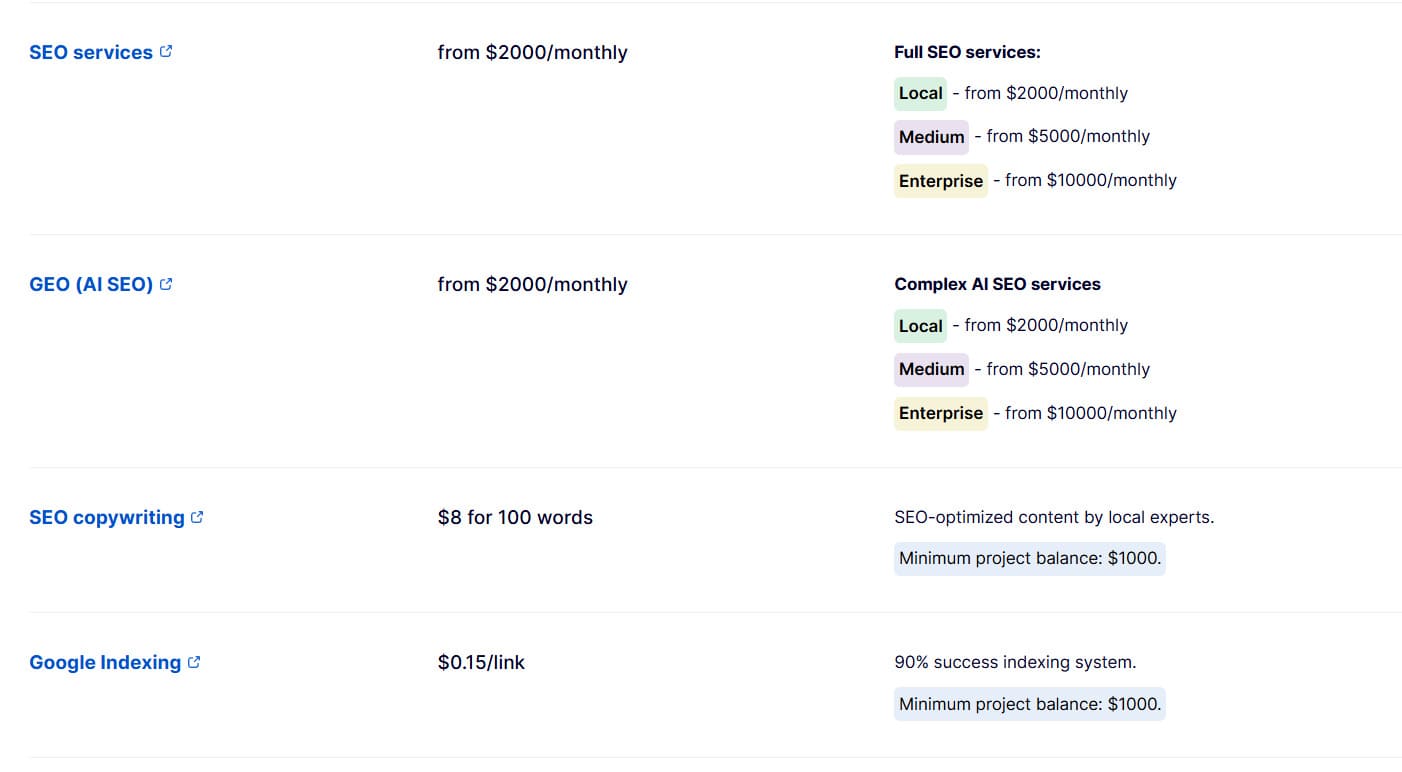
We form prices based on the benefit and ROI of SEO for a specific business. We don't hide costs or push additional paid services – you can see all the details on our Pricing page, but here’s the overview:
- Local / Smaller Projects: Starting from $2,000/month.
- Medium-Sized Businesses: Starting from $5,000/month.
- Enterprise-Level Projects: Starting from $10,000/month.
Will Prices Go Up in 2026?
We adjust prices once a year to reflect market expertise, tool costs, and service depth. This doesn't necessarily mean a price increase: when we improve internal processes, automate routine tasks, and speed up task execution, some work may become cheaper.
On the other hand, if demand grows or clients start ordering more services within one project, the total check may increase not due to a price hike but due to a larger volume of work. The cost of our services always adapts to real tasks, not just a desire to "sell for more." Any changes are always communicated with transparency.
The ROI: How SEO Pays for Itself

When a business invests in SEO, it pays for growth that eventually starts working on its own. The effect isn't immediate, but as the site strengthens its positions, traffic reaches a stable trajectory and becomes independent of advertising. Every invested dollar starts yielding more return.
ROI is especially evident when a business understands its conversion clearly. Suppose you are a medium-sized e-commerce project wanting to increase traffic and conversion rate. You choose a standard package for $5,000/month. In the first month, we conduct a technical audit, fix errors, and update the catalog structure. The second and third months focus on content and link building. After 3–6 months, positions grow, traffic increases, and conversion rises.
As a result, organic traffic brings +100–150 additional leads per month, with an average lead value of $200. Even if some are cold leads, if at least 30 inquiries result in sales – you recoup your investment with a margin.
And when you stop paying per click, the difference between revenue from organic traffic and SEO cost per month 2026 becomes increasingly tangible. Within six months, SEO transforms from an expense item into a profit source. This effect occurs with a systematic approach: working on the site, content, and links, not expecting growth after one or two actions.
You can review our real case studies and client results on the "Case Studies" page.
Setting Your SEO Budget: A Practical Guide
A smart SEO budget isn't just "how much we are willing to spend." It's a balance between ambitions, the competitive environment, and realistic timelines. Below is a detailed guide to help understand what budget is truly needed for SEO to bring tangible and predictable results.
The Three Budget Pillars

The foundation consists of just three things – what you want to achieve, how complex your niche is, and within what timeframe you plan to get results. These three factors determine the scale of work and how aggressive the strategy should be.
Business Goals
Your tasks directly determine the budget. Want to increase traffic by 20%? Or reach the top 10 for a list of important keywords? Or enter a new region?
Each goal requires a different volume of work: sometimes content is needed, other times a large number of links, and sometimes a deep technical reconstruction of the site.
Competition Level
The more complex the niche, the more resources will be needed. For example:
- A local niche with few competitors will require a minimal budget.
- E-commerce with thousands of product pages and strong players implies much larger investments.
- SaaS in the international segment is always highly competitive, requiring serious investment in content and links.
Timeline for Achieving Results
In SEO, speed = money.
If you need rapid growth, a more aggressive strategy is required: a powerful content plan, more links, an expanded technical block. If timing isn't critical, the budget can be distributed more evenly.
Checklist: Calculating the Optimal Budget for Small Business, E-commerce, and SaaS
To help business owners navigate more easily, below is a detailed checklist with benchmarks by category.
📍 Small Business (local companies, services, small websites)
What's usually included:
- Local SEO (Google Business Profile, directories, reviews).
- Work on several key site pages.
- Writing 2–4 articles per month.
- A small link package.
- Periodic technical audit.
Optimal budget: from $500 to $2,500/month.
For a small business, this budget range is sufficient for steady growth and staying ahead of local competitors.
🛍 E-commerce (online stores)
What to factor in:
- Work with a large number of categories and product pages.
- Massive content: descriptions, guides, comparisons.
- Constant link building, including guest posts.
- Fixing technical issues on large sites.
- Analyzing the competitive product matrix.
Optimal budget: from $3,000 to $10,000/month.
SEO for e-commerce is the most labor-intensive category. There are many pages, high competition, and a large volume of work.
🌎 SaaS (including international services)
Specifics:
- Competition with the strongest players in the international market.
- High demands on content (expertise, analytical materials, reviews).
- Complex link building focused on strong media.
- Need for a large-scale content strategy: blog, documentation, guides, landing pages for intents.
- Constant A/B analysis and conversion optimization.
Optimal budget: from $5,000 to $25,000+/month.
For SaaS, SEO is an investment that scales the product. With an insufficient budget, it's simply impossible to compete.
Top 3 Mistakes That Risk Wasting Your Money
By understanding the most common mistakes in advance, you can protect your budget and achieve real growth instead of spending money on activities that yield no results.
❌ Mistake #1. Budget Not Linked to Goals
The most common and most expensive mistake.
A business sets ambitious goals – reaching top 3, 2–3x growth, entering a new market – but allocates a budget suitable only for maintenance work.
What happens:
- SEO specialists cannot complete the stated volume of content or links.
- Technical problems are solved partially, "spot-fixed."
- The result is weak, and the money is spent.
Example: A company wants to enter the US SaaS market but allocates a budget as for a local site. Result – no reach, no growth, only disappointment.
How to avoid: Before forming a budget, always determine the scale of the task and the competitiveness of the niche. This is the foundation; without it, any budget will miss the mark.
❌ Mistake #2. "Trying a Little Bit at a Time"
This is the approach where a business owner allocates minimal amounts to "test if SEO works." But SEO isn't Pay-Per-Click: small doses simply don't produce an effect, and you get neither data nor results.
Typical traps:
- Ordering 2–3 articles per month in a competitive niche.
- Buying a few links without a strategy.
- Attempting to "tweak technical aspects" partially without fixing fundamental issues.
The outcome:
- You see no growth.
- Conclude "SEO doesn't work."
- Lose several months and pay again to start over.
How to avoid: Discuss with specialists in advance the minimum required to initiate growth in your niche and don't go below it.
❌ Mistake #3. Ignoring the Long-Term Approach
SEO is an investment, not a one-time campaign. If you "turn off" SEO after the first successes, the site quickly loses positions: competitors continue to strengthen, content becomes outdated, and links stop working.
Common scenarios:
- A company gets its first leads, decides "why pay further," and stops working on SEO.
- Changes contractors every 2–4 months, looking for "cheaper options."
- Doesn't update content.
- Stops link building after the initial push.
Result – loss of invested effort, positions dropping back 3–6 months.
How to avoid: Plan SEO for at least 6–12 months, or better yet, as a permanent element of marketing.
The Hidden Cost of “Cheap” SEO

Cheap SEO almost always leads to expensive consequences: increased risk of penalties, loss of site positions, and fixing errors costs several times more than proper promotion from the start.
Why Cheap SEO Doesn't Work
This section is about what's usually hidden behind "attractive" offers and savings.
A Low Price Lacks Resources for Real Work
SEO isn't a one-button solution. It's content, technical optimization, link building, analytics. Each of these parts requires time and specialist work. A price below market means either no work at all or unqualified work.
What happens in such cases:
- Superficial audits that change nothing are created.
- Weak texts or unedited AI-generated content are published.
- Links are bought from irrelevant, non-authoritative sites.
- Formal reports without real results are provided.
Result – no growth, sometimes even a traffic drop.
Use of "Black-hat" and "Gray-hat" Methods
To show quick effects, low-cost providers often use low-quality PBN networks, automated content generation, mass directories.
The problem with such methods:
- They don't provide long-term growth.
- They increase the risk of Google penalties.
- They damage the site's reputation.
A search engine penalty means minus traffic, minus leads, and minus internal team resources for recovery.
Cheap SEO Lacks Strategy
Instead of analyzing the niche, competitive environment, site weaknesses, and business strengths, the client is offered a standard set of actions: the same "checklist" audit, identical texts, typical links, and reports that don't change for months. Such work doesn't lead to growth because it doesn't solve your specific tasks.
Every site is a separate ecosystem: its own technical nuances, different indexing speeds, different domain authority, different goals. But cheap SEO ignores this reality: it's simply not profitable for the provider to spend time on analysis and strategy.
Without strategy, SEO turns into a set of actions for the sake of ticking boxes – and this is precisely the case where "cheap" ends up being the most expensive because you pay for work incapable of driving growth.
Hidden Costs and Upsells: What to Look for in a Contract
Even when the starting price looks attractive, the final amount often ends up higher. There are several common "traps."
- Basic Tariff Without Key Work. The price seems low, but you'll have to pay extra for full promotion. For example:
- Technical audit – a separate paid service.
- Content optimization – an additional charge.
- Link building – separate cost.
- Implementation of recommendations – not included, "contact your developer."
- Internal Upsells Unrelated to Results. Typical scenario: the contractor monthly proposes to "add 10 more links," "buy additional articles," "raise work limits," without explaining why. This makes the budget unpredictable.
- Limited Task Volume in the Contract. Example: "up to 5 tasks per month." For a site with a large volume of work, this means long deadlines and gradual cost increases.
- Mandatory Long-Term Commitment. Contracts with cheap SEO agencies often include:
- Obligation to work for 6–12 months.
- Penalties for early termination.
- Restrictions on task rescheduling.
This format benefits only the contractor.
- Extra Charges for Basic Things. There are also small but unpleasant instances:
- Separate payment for reports.
- Fee for access to services/tools.
- Buying tools through the contractor at inflated prices.
Always discuss all work and review the contract before signing.
Five Signs Something Is Wrong With Your SEO Contractor

These signs will help you understand that the budget is being spent inefficiently and the work needs monitoring:
🚩 Reports Exist, But Actions Don't
Contractors send beautiful graphs and tables. But if the report lacks specifics – which pages were optimized, which keywords were advanced, which errors were fixed – it's a warning sign.
Example: The report shows 5% traffic growth but doesn't explain what caused it. In practice, this could be a seasonal spike or an external factor, not the result of SEO work.
Solution: Demand reports with breakdowns by tasks, deadlines, and specific site changes.
🚩 No Access to Tasks and Work Plan
Work transparency is a key criterion. If the contractor doesn't provide access to a personal dashboard or work tracker, you don't see what's actually being done. Then you're paying for promises, not actual results.
Good practice: Agree on a roadmap for 3–6 months, indicating priority tasks, deadlines, and expected results.
🚩 Low-Quality or Fully AI-Generated Content
Content directly impacts site rankings. If the contractor uses automated texts without editing and fact-checking, you get:
- Poor readability.
- Low user dwell time.
- Poor ranking.
- Potential search engine penalties.
Example: The site receives hundreds of articles, but they don't address user needs or attract leads. This approach saves the contractor's time but wastes the client's money.
Solution: Agree with the contractor on the content preparation and verification process.
🚩 The Contractor Doesn't Ask Questions About Your Business
If you aren't asked questions about the product, target audience, competitors, business model – it's a serious red flag. SEO without understanding the company's goals turns into a set of mechanical actions.
Example: The contractor promotes pages for keywords that don't generate leads because they don't match your audience.
Solution: Ensure there's a discussion about the target audience, competitors, and business goals before starting.
🚩 The Contractor Promises Rapid Growth
SEO doesn't provide instant results. If a contractor promises top 3 in 2 weeks, top 10 in a month, or guaranteed positions – it's a marketing trick.
The real process:
- Technical optimization takes weeks.
- Content and link building take months.
- Positions grow gradually, with a cumulative effect.
Consequences of promises of "lightning-fast SEO":
- Use of gray methods, PBNs, and automatic links.
- Penalties and filters from search engines.
- Loss of budget without long-term effect.
Expert Forecast: Where Are SEO Prices Heading in 2026?
SEO prices always grow unevenly and depend on the specific business, competition level, and technologies used. Our expert Roman Malyshev shares forecasts based on market analysis and experience working with clients of different scales.
Why Client Invoices Are Growing While Cost Per Useful Action Is Falling
The growth in overall client invoices is related to business expansion, opening new directions, and testing new markets.
Example: A company launches an e-commerce store and simultaneously enters the EU and US markets. Each new direction requires separate work with content, links, and local optimization.

In fact:
- Previously, a specialist spent an hour manually fixing errors or selecting keywords.
- Now, some tasks are automated, reducing the cost per specific task.
- But the volume of tasks increases, so the overall client invoice grows.
That is, the business pays more but receives more value and leads, and the efficiency of each dollar increases.
What Will Be the Main Pricing Trends in 2026?
Two main trends can be highlighted: AI automation and the rising cost of expertise.
Trend 1: AI and Process Automation
Artificial intelligence speeds up routine tasks: competitor analysis, initial keyword research, content structure generation, mass link checking. As mentioned, this automation reduces costs for individual operations and speeds up specialists' work.

Trend 2: Rising Cost of Expertise
At the same time, search engines demand more expert content, proof of authorship, and reliability (E-E-A-T). This means experienced SEO specialists, copywriters, and analysts become more expensive.
The final combination of these trends:
- Cheaper to perform routine tasks.
- More expensive to create strategy, expert content, and high-level link building.
- The overall project price increases, but efficiency per unit of work improves.
Our Forecast for Price Ranges by the End of 2026
Let's look at approximate ranges by region and business type:
CIS:
- Small business – $300–$1,500/month
- Medium business – $1,500–$5,000/month
- Large projects – $5,000–$12,000/month
EU:
- Small business – $1,000–$3,000/month
- Medium business – $3,000–$7,000/month
- Large projects – $7,000–$15,000/month
USA:
- Small business – $1,500–$5,000/month
- Medium business – $5,000–$15,000/month
- Enterprise – $15,000–$25,000+/month
Local Projects (small cities/regions):
- $150–$800/month
Even with overall invoice growth, businesses receive more value. Companies using automation and strategic expertise can reduce costs per unit of action and achieve ROI on SEO investments faster.
In 2026, the SEO budget depends not only on market price levels but also on tasks, company scale, and quality of expertise. Budget planning and choosing the right approach remain key success factors.
Conclusions: How to Choose an SEO Package That Pays Off, Not Becomes an Expense
Choosing an SEO package directly impacts investment efficiency. Different sets of services, approaches, and business goals create a huge price range. Understanding what you pay for helps avoid overpaying and getting real results.
Why the Price Range Reflects Different Levels of Expertise
Typical SEO prices 2026 vary because services differ in depth, number of tasks, and specialist professionalism. A cheap offer often hides minimal work volume or automation without strategic value. An expensive package includes technical SEO, content, link building, and strategic solutions, ensuring real effect.
That's why it's important to look not at the price as a number, but at what's included in the package and how it helps achieve your goals.
Who Needs Just a Consultation, and Who Needs a Comprehensive "Turnkey" Package
What SEO cost per month 2026 amounts to depends on business scale and goals:
- If the business is new, wants to test the market, and try promoting on its own, you can include only the cost of SEO 2026 for a consultation or one-time audit in the budget. This way, you get startup recommendations you can implement yourself.
- A one-time consultation or audit can also suffice if you're already doing SEO yourself and rankings suddenly start dropping. An "outside view" is useful here: perhaps you're missing technical errors or stronger competitors have emerged.
- A "Turnkey" package is a solution for those wanting to fully outsource SEO and get guaranteed results. Here, the budget must account for the cost of comprehensive SEO, including content, technical optimization, link promotion, and analytics.
- Companies with ambitious growth, scaling, or market entry goals also need a comprehensive package.
Ready to Start? We'll Analyze Your Project and Provide a Realistic Budget Forecast
To determine the average SEO cost 2026 specifically for your project, you need to assess:
- Goals and expected results.
- Competitive niche.
- Website scale.
- Desired timelines.
At LinkBuilder.com, we conduct individual analysis for each client. Based on this, you'll receive a transparent budget forecast, tariff recommendations, and an understanding of how much does SEO cost in 2026 considering your tasks.
Don't waste time on guesswork and trial strategies – contact LinkBuilder.com, and we'll prepare an SEO plan for 2026 that pays off and delivers results.