 Link building
 Guest Posting
 Niche edits
 Profile backlinks
 Crowd links
 Submission links
 Contextual Backlinks
 White-label link building
 PBN Building
 Haro links
 Digital PR
 SEO
SEO
 SEO copywriting
 Google Indexing
 Quora links
 Add to catalogs
 AI SEO
 Reddit

Websites can outgrow their original structure. New sections, product lines, country targets, and content types pop up. That’s when you face the big architectural question: subdomain or subfolder? Getting this choice wrong can hurt your visibility, link equity, and traffic.
Let’s look at how Google actually treats subdomains and figure out where they make strategic sense.
Subdomains and SEO: The Basics and Google’s Perspective
First, you need to understand the role subdomains play in your site’s ecosystem.
Subdomains let you spin off a section of your project outside the main website. It’s a way for businesses to manage distinct segments without restructuring everything.
But the connection between subdomain SEO and your main site’s health is stronger than many realize. Picking the wrong setup impacts indexing, user experience, and how authority is perceived.
The Technical Lowdown: Subdomain vs. Subdirectory
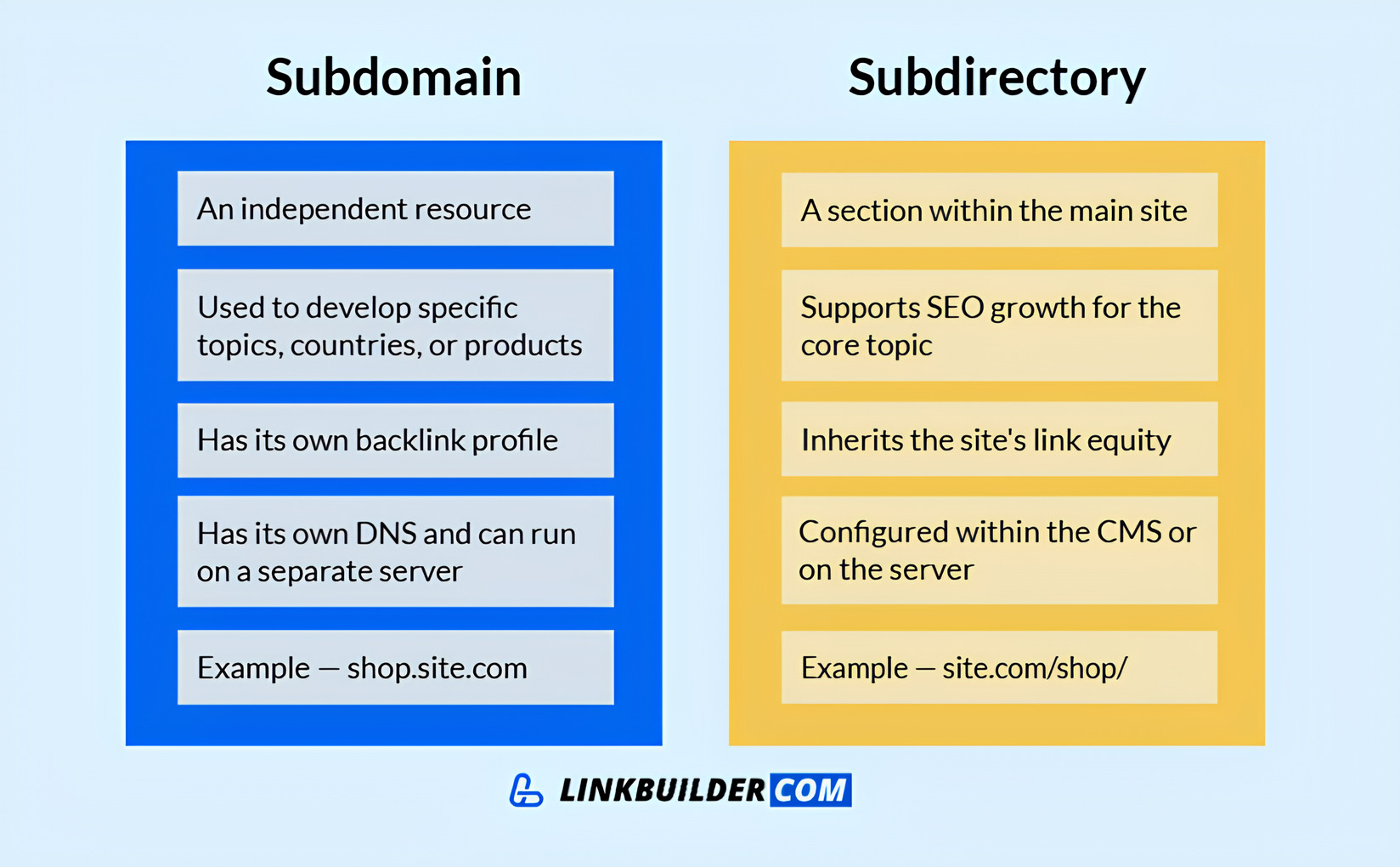
In simple terms: a subdomain is a separate address like blog.yoursite.com. A subdirectory lives under your main domain, like yoursite.com/blog. You can see real examples on our own site:
- linkbuilder.com – our main hub.
- linkbuilder.com/blog – our blog, in a subdirectory.
- app.linkbuilder.com – our tool, on a separate subdomain.
The difference isn’t just cosmetic. Technically speaking:
- A Subdomain is a separate zone at the DNS level. It behaves like its own site. It can have its own server, configuration, and requires its own subdomain SEO strategy.
- A Subdirectory (or subfolder) is part of the main site. It shares the main domain’s DNS, usually runs on the same infrastructure, and inherits settings like SSL certificates and core files. This makes it simpler to manage with one robots.txt and sitemap.xml.
Here’s a quick visual comparison:
How Do Subdomains Impact SEO? Separate Site or Team Player?
Google is clear on this: subdomains are treated as separate entities for ranking. The search engine builds a distinct profile for each one – crawling, indexing, links, and user signals are tracked independently.
Authority from the main domain doesn’t directly transfer. It can help indirectly through cross-linking and shared brand recognition, but that’s about it.
A subdomain builds its own reputation. It earns its own backlinks, creates its own content, and generates its own user engagement data. If your blog.yoursite.com earns great links, they boost that subdomain’s rankings in Google, not your main yoursite.com site.
This is a double-edged sword. If you’re launching a project with a totally new audience or topic, a separate subdomain gives you freedom. But if you’re counting on an instant traffic boost from your main domain’s authority, you’ll be disappointed. So, should you use subdomains for SEO? Only if you’re prepared to treat them as standalone projects, because that’s how Google sees them.

A subdirectory, in contrast, shares the main domain’s signal base. Pages in subfolders can rank faster because the domain already has trust with Google. For launching new content areas where early traffic matters, this is usually the easier path.
On-Page Optimization: What’s Different for Subdomains?
Optimizing a subdomain is like optimizing a new website from scratch. You need unique metadata, a dedicated content plan, internal linking, and full technical setup. When we talk about managing SEO for subdomains, the workload multiplies.
Here are the key differences:
- Each subdomain needs its own sitemap, registered in Google Search Console.
- Duplicate meta tags between your domain and subdomain hurt both; each needs original, targeted metadata.
- Internal linking starts over. Links between the main site and subdomain count as external links.
- Performance, code quality, and user behavior are tracked separately for each.
If the subdomain is for a local market, the content must be region-specific. If it’s for a new topic, it needs its own expert structure. In short, a subdomain grows as its own system.
Getting this setup right prevents indexing issues and duplicate content problems. It’s the foundation of any successful subdomain SEO best practices.
The Great Debate: Subdomains vs Subdirectories SEO
This is one of the most strategic choices in technical SEO. It dictates how you’ll manage authority, traffic, and resources for years to come. Your decision affects everything from your link building budget to how complicated your analytics get.
Subdomain vs Subfolder SEO: What’s Actually Better?
There’s no one-size-fits-all answer. Search engines, including Google, can handle both just fine. The real question is: which structure fits your business goals and operational capacity?
A subdirectory benefits from the link equity of your main domain from day one. It grows faster, especially for related topics. That’s why major sites often keep their blog, guides, and service pages in subfolders.
A subdomain operates as its own platform. It makes sense when a section needs independent branding, unique content, and a separate link-building approach. That’s why forums, documentation portals, or fully separate regional sites often live on subdomains.
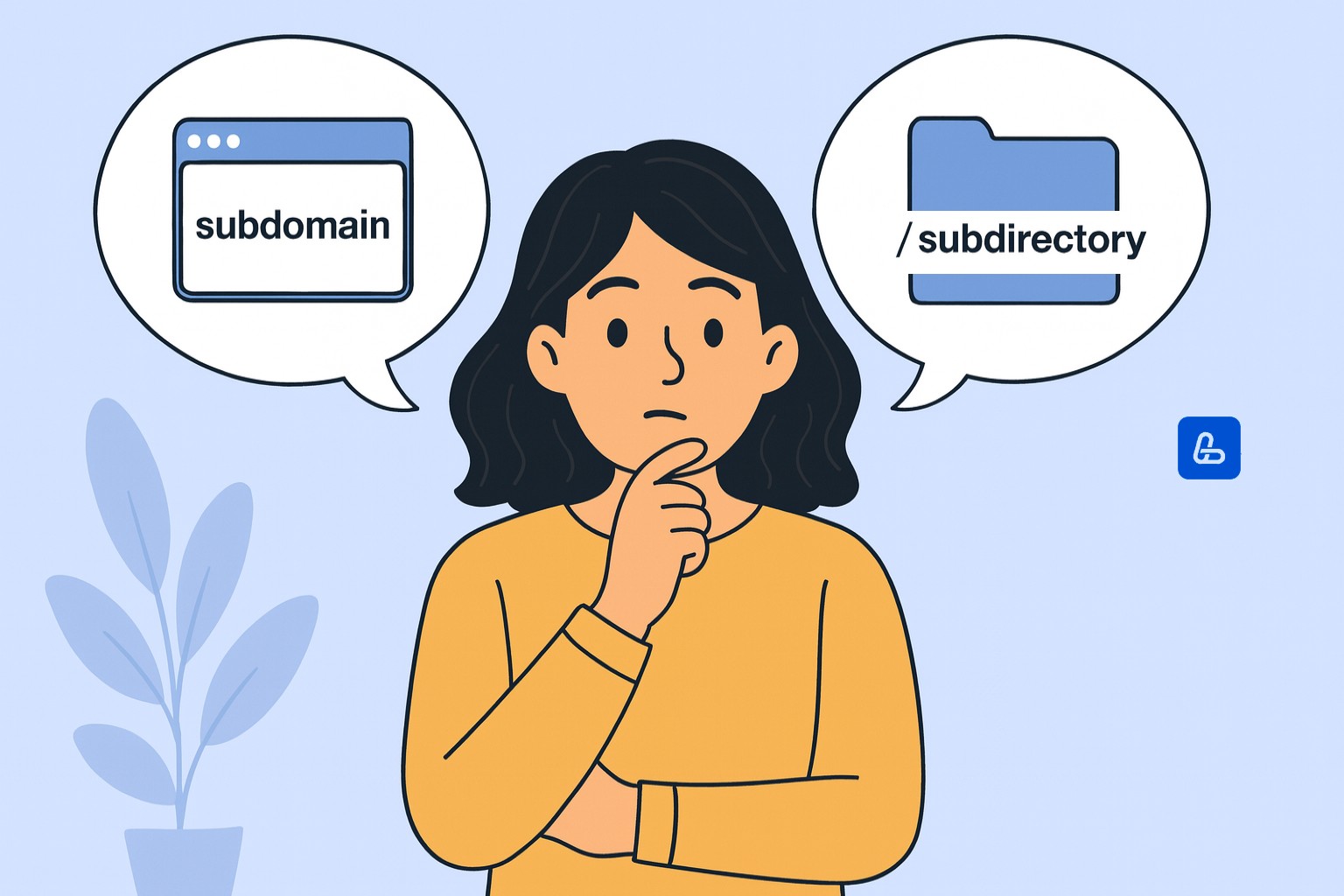
This is the heart of the “subdomains vs subdirectories SEO” debate. Sometimes, a subfolder makes your main site stronger. Other times, it just creates a clunky, mixed-message site. A subdomain offers flexibility but demands the resources of a new launch.
How This Choice Impacts Core SEO Factors
Let’s break down the effects on what really matters.
Link Equity: Sharing vs. Hoarding
This is the biggest factor. A subdirectory is part of the domain. Any link to yoursite.com/blog/article/ directly boosts the authority of the entire yoursite.com. You concentrate your power.
Subdomains are different. Links to your main domain offer little to no “authority boost” to your subdomain, and vice-versa. Each subdomain must build its own link profile from the ground up, requiring separate link building campaigns.
Indexing & Ranking: Unified vs. Split Signals
Google crawls subdirectories as part of the main site. They benefit from the domain’s established crawl budget and history. Subdomains get their own crawl budget and their own set of ranking signals.
This separation can be useful. For example, if your main site is a hard-selling e-commerce store, an independent, expert blog on a subdomain (blog.yoursite.com) can build credibility without the commercial noise. But done poorly, it splits your efforts. Your own domain and subdomain can end up competing for the same keywords, cannibalizing your traffic.
User Experience & Behavioral Signals
Users often see a move to a subdomain as leaving your site, especially if the design or navigation changes. This can hurt key metrics: time on site may drop, pages per session may fall, and bounce rates can climb.
A subdirectory provides a seamless experience. The navigation is familiar, and the branding is consistent. This builds user trust and improves engagement metrics, which Google uses to judge site quality.
Busting Common Myths About Subdomains and Subfolders

Let’s clear up some outdated ideas that can lead you astray.
Myth 1: “Google hates subdomains; they never rank well.”
Reality: High-quality subdomains with great content and strong links rank just fine. The issue isn’t a technical penalty; it’s the sheer amount of work required. Giants like docs.google.com show that subdomain impact on Google rankings isn’t the problem. The challenge is building that level of authority from scratch.
Myth 2: “Subdomains are always better for SEO than subfolders.”
Reality: This is leftover from early SEO days. Subdomains are justified for true separation (like different countries or completely different services). For most content related to your core business, subfolders are simpler and more effective.
Myth 3: “Google automatically merges the authority of my domain and all its subdomains.”
Reality: Google’s algorithms are smart enough to see the connection through branding and linking. But for ranking purposes, the signals are not fully or automatically combined. Each subdomain’s performance is evaluated on its own merit.
Myth 4: “A subdomain is a shortcut to ranking for new keywords.”
Reality: This is a dangerous assumption. A new subdomain starts with near-zero trust. It can take months of dedicated content and link building to rank for anything competitive. A subfolder, leveraging your main domain’s authority, will almost always get traction faster.
Myth 5: “I can use a subdomain to dodge a Google penalty on my main site.”
Reality: Technical separation isn’t a shield. If you use a subdomain for spammy or manipulative tactics, it will get penalized. And if its connection to your main brand is obvious, there’s a real risk that penalty could spill over.
The Bottom Line: Subdomain or Subfolder?
| Consideration | Subdomain | Subdirectory / Subfolder |
|---|---|---|
| Link Equity | Built in isolation. Little direct help from the main domain. | Built collectively. Every link strengthens the entire site. |
| Indexing & Ranking | Creates its own reputation. Risk of internal competition. | Benefits from the domain’s unified reputation. No internal competition. |
| Technical Setup | More complex. Needs its own SSL, robots.txt, sitemap, tool tracking. | Simpler. Inherits the main site’s global settings. |
| Management & Analytics | Data is siloed. Requires consolidated reporting. | Data is centralized. Full site picture is immediate. |
| Flexibility | High. Can use different tech stacks, servers, teams. | Low. Tied to the main site’s platform and infrastructure. |
| User Experience | Can feel like a different site. Requires effort for consistent branding. | Feels seamless and integrated, building user trust. |
| Best For | Large, distinct projects: int’l sites (de.site.com), separate apps (app.site.com), major verticals (news.site.com). | Core site content: blog, services, product catalog, portfolio, knowledge base. |
So, subdomain vs subfolder SEO? It depends. If your goal is to consolidate power, use a subfolder. If your goal is to strategically isolate a project, use a subdomain.
When Subdomains Make Strategic Sense
When used correctly, subdomains are a powerful tool. They’re worth the extra effort in specific, complex business scenarios.
The Real Benefits of Subdomains for SEO
Four key advantages make subdomains a smart strategic move:
- Clear Thematic Separation for Algorithms. Launching a project in a completely new field? A subdomain sends a clear signal to Google: “This is a separate topic.” This prevents topic dilution. For instance, a medical device sales site launching a peer-reviewed journal should use a subdomain. It protects the commercial site’s E-E-A-T (Experience, Expertise, Authoritativeness, Trustworthiness) profile. IBM does this with research.ibm.com separate from ibm.com.

- Operational & Technical Independence. Different teams (marketing vs. dev support) can run different subdomains without stepping on each other’s toes. You can also use best-in-class platforms (e.g., a Shopify store, a WordPress blog, a Discourse forum) under one brand.
- Risk Containment. Test a new design or business model on a subdomain without jeopardizing your main site’s SEO. If it fails, the damage is contained.
- Dedicated Branding for Different Audiences. developer.software.com for coders and partner.software.com for resellers can have totally different content, design, and tone.
Subdomains for International SEO: Getting Local Right
Geography is one of the most common applications. When a company expands to other countries or regions, a structure like uk.site.com or de.site.com provides clear separation of languages, local pages, and local content.
This approach is justified in the following scenarios:
- Full regional autonomy. You have a separate office, a local team, your own warehouse, and a unique offer for the country. A subdomain emphasizes this independence and is better perceived by the local audience.
- Legal requirements. In some jurisdictions, physical hosting of the site within the country or clear territorial separation may be required. A subdomain technically solves this task more easily.
- Different brands or partners. If you work in a country through a franchise or partner, a subdomain logically separates their activities.
In these cases, it is optimal to use subdomains for international SEO. Each country receives its own signals, its own pages, its own marketing. Google perceives each zone as a separate resource with its own market.
Note: For companies that simply want to translate content and adapt prices, subdirectories with hreflang (company.com/de/, company.com/fr/) are a simpler and more effective path. They preserve overall link equity and simplify management.
Subdomains for Distinct Topics: Use Cases by Industry
Topic is the second major scenario. When a project grows, directions appear within it that should not depend on the main content. In e-commerce, this is often a blog, community, or educational sections. In SaaS – documentation, knowledge base, developer portal. In media – thematic verticals. In education – separate courses, catalogs, thematic schools.
This is where subdomains for separate topics in SEO appear. They are used when:
- content is designed for a different audience;
- the structure requires independent templates;
- separate experts, authors, and editors are needed;
- the load is high and it's better to separate the server;
- the quality of topics varies and does not fit the overall strategy.
This forms a logical architecture where subdomains work as independent platforms. Here are a few subdomain SEO examples for different niches:
- E-commerce and major brands:
- Review system: reviews.brand.com. Allows the use of specialized software for moderation and display of ratings without overloading the main product CMS.
- Outlet or sales: sale.brand.com. Isolates aggressive commercial promotions, preserving the premium image of the main site.
- Loyalty program: club.brand.com. Creates a sense of an exclusive space for regular customers.
Example: The Nike store has a separate subdomain for investors – investors.nike.com.

- SaaS companies:
- Main application: app.saas.com. Functional interface.
- Documentation and help center: help.saas.com or docs.saas.com. Often runs on a separate platform (e.g., Zendesk or ReadMe).
- Community and forum: community.saas.com or forum.saas.com. For user support and discussions.
- System status: status.saas.com. Tracking service availability (often on UptimeRobot or Statuspage).
Each of these elements is so specific that its allocation to a subdomain is justified for both users and internal processes. This is a competent subdomain SEO strategy.
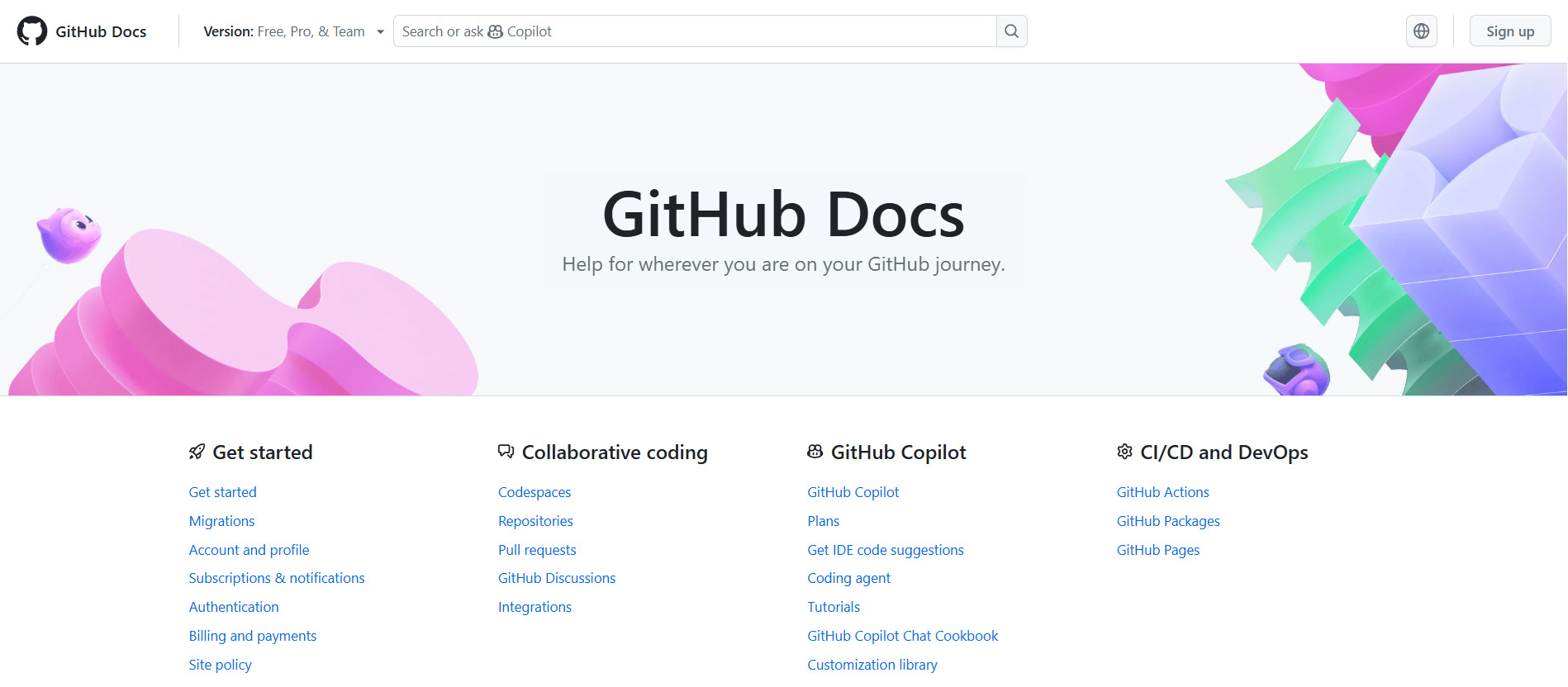
Example: GitHub documentation on the docs.github.com subdomain.
- Media holdings and publishing houses:
- Thematic verticals: tech.media.com, auto.media.com, realty.media.com. Allows each direction to build its own expert authority in the niche, have a separate editorial team, and even separate monetization. For Google, this is a clear signal of topic coverage depth.
Example: The New York Times has a cooking.nytimes.com subdomain with recipes.

- Educational institutions and corporations:
- Online learning: courses.university.com or learn.corporation.com. An LMS platform (Moodle, Teachable) is logically placed on a subdomain.
- Career: jobs.corporation.com. Often runs on a separate HR service (Greenhouse, Lever).
- Research: research.university.com. Separation of academic activity.
Example: Harvard's subdomain for professional and lifelong learning – pll.harvard.edu.

The rule of thumb: if the new section is as big and complex as a separate business line, a subdomain is likely the right choice. If it’s just another content category, use a subfolder.
Risks of Subdomain SEO and How to Sidestep Them
Subdomains provide control, and with it, new responsibilities. Mistakes here are more noticeable than in subdirectories.
Dilution and Duplication: The Risk of Competing with the Main Domain for the Same Queries
When a subdomain overlaps in topics with the main site, both resources appear in search results for the same queries. This creates competition. Google chooses one page and pushes the other lower. Traffic fluctuates, and positions jump.
Dilution occurs when content copies the structure of the main site or repeats semantic groups. Moving sections to sub.site.com without clear logic leads to both platforms receiving the same signals. The search engine doesn’t understand which resource is primary.
How to avoid:
- Strict semantic separation. Before launching a subdomain, conduct an audit and distribute the semantic core. For example: the main domain should answer transactional and commercial queries (buy, order, price), the subdomain – informational and research (how to choose, what is better, review, guide). There should be minimal overlap for high-frequency queries.
- Clear mission definition. Formulate for yourself: “The main site sells, and the blog on the subdomain educates and generates leads.” This will help in content planning.
Then competition won’t arise, and each address will strengthen its cluster.
Link Building Complexity: The Need to Build Link Mass Almost from Scratch for Each Subdomain
The link base is the main barrier when working with subdomains. Each new address starts as a separate site. It does not receive authority automatically. Even if the main domain is strong, the subdomain still needs external links, mentions, crowd marketing, guest posts, and thematic publications.
Hence the problem: the more subdomains, the more separate campaigns. One blog, one regional site, one documentation – and for each direction, a separate link-building network needs to be built. Without this, the subdomain won’t reach the top, even if the content is strong and the structure is clean.
When a project expands, the load increases exponentially. The team has to:
- conduct outreach for each topic;
- plan budgets for different platforms;
- monitor the naturalness of links in each zone;
- balance anchors for different subdomains.
A mistake in one direction affects the growth of the entire project. That’s why many companies outsource link work to agencies specializing in promoting complex structures.
This is where LinkBuilder.com comes into play. The agency works with multi-domain projects and builds comprehensive campaigns for each platform. This helps avoid the typical subdomain problem – slow growth due to lack of links.

We provide:
- Custom strategies per subdomain.
- Outreach to niche and regional sites.
- Transparent reporting and forecasts.
- Safe, scalable link acquisition.
This frees your team to focus on content and product, not just link outreach. Get in touch to build your subdomain strategy.
Technical Complexities: Managing Separate Configurations for Each Subdomain
Every new subdomain means starting from scratch: a new robots.txt, another sitemap.xml, a fresh SSL certificate, and a separate property in Google Search Console. While manageable for one or two subdomains, this overhead multiplies quickly, making human error almost inevitable as your network grows.
Common pitfalls include:
- Misconfigured robots.txt directives blocking critical pages.
- sitemap.xml files that fall out of sync with new content.
- An expired SSL certificate causing a subdomain to drop from Google’s index.
- Analytics and tracking fragmented across multiple accounts.
These issues disrupt indexing, skew your data, and inflate maintenance time.
How to avoid: Implement a launch checklist for every new subdomain. Mandatory items should be: “Verify SSL,” “Create and submit robots.txt and sitemap.xml,” “Add and verify property in GSC and GA4.” Proactively maintain a central registry of all subdomains and subject them to regular technical audits.
The Analytics and Management Headache
A single-domain site offers a clean view: one GA4 container, one Search Console, one set of unified reports. Subdomains shatter that simplicity.
You lose the ability to assess overall project health at a glance. Organic traffic, keyword rankings, and crawl errors are siloed across different dashboards. Each subdomain demands individual attention, yet you must still grasp the collective performance.
How to avoid: The solution is data consolidation. We’ll cover practical steps to achieve this in the upcoming section, “Building a Comprehensive SEO Strategy When Using Subdomains.”
Building an Effective SEO Strategy for Subdomains
For subdomains to deliver a return, they need a deliberate strategy, fully integrated with your core business objectives. Think of it as an ecosystem where every component – from a single backlink to a monthly report – works in concert toward a unified goal.
Integration into Overall Promotion: Fitting Subdomain SEO into the Big Picture
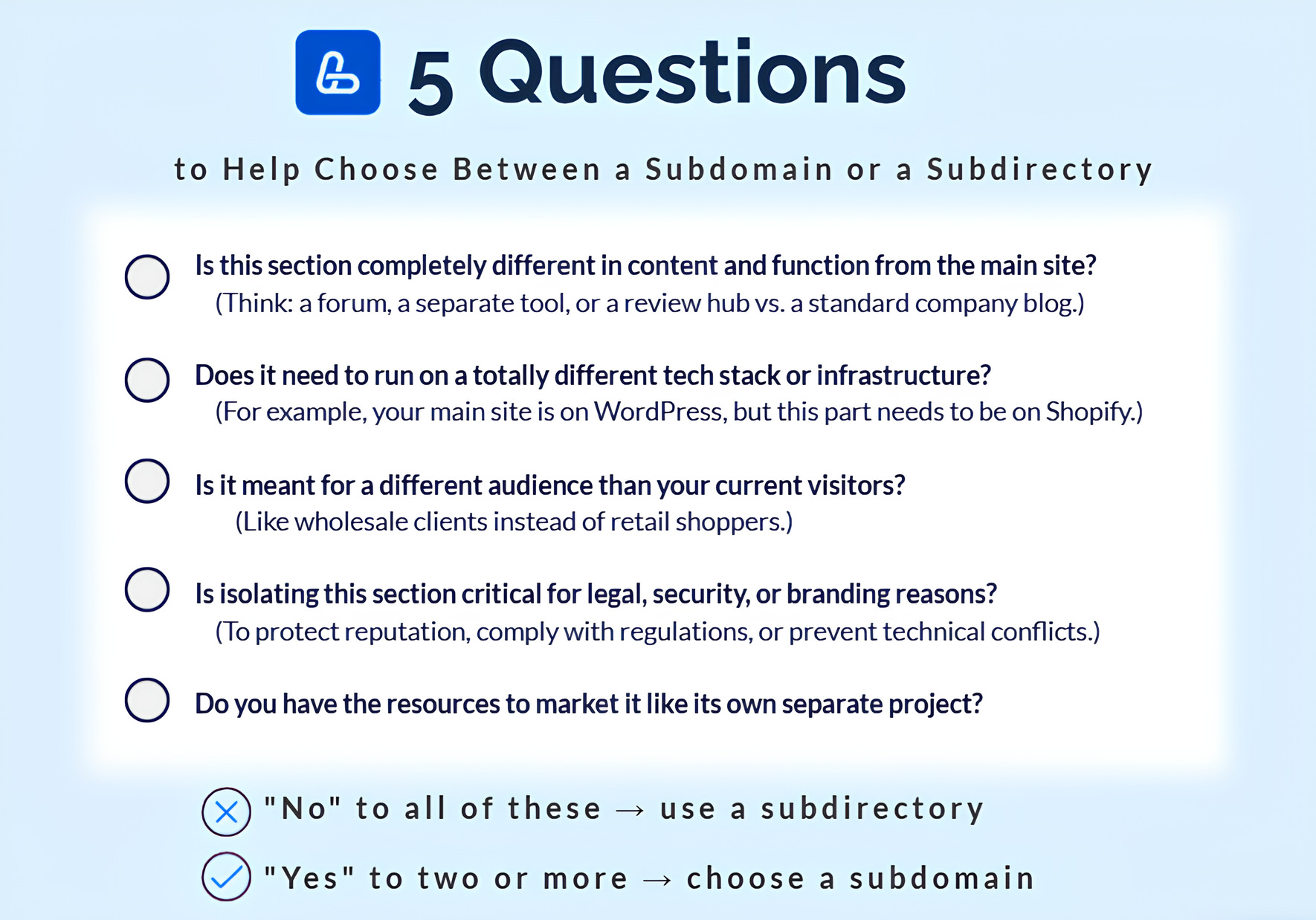
The simplest mental model is to treat a subdomain as an affiliated site. It should operate within your brand’s ecosystem but with the autonomy to grow on its own. This prevents signal dilution and allows each subdomain to build authority in its specific niche or region.
To weave subdomains into your broader promotion strategy, follow these steps:
- Define the Role of Each Property. Clearly document what marketing job each subdomain performs. For example: Main domain = direct sales conversions. Blog subdomain = traffic acquisition and lead generation. Help center = reducing support tickets and capturing “how-to” search queries.
- Build a Unified (But Segmented) Keyword Strategy. Develop a master keyword database, then strategically allocate topic clusters between your main domain and subdomains to minimize internal competition.
- Synchronize Content Calendars. Plan content on your subdomain blog that naturally supports and links to product pages on the main site, and vice-versa. This creates a cohesive content narrative.
- Establish Shared Budgets and KPIs. Your overall SEO budget must allocate specific resources for subdomain support and promotion. Set KPIs that track both overall brand growth (total organic traffic) and individual subdomain performance.
This structured approach transforms a potential management nightmare into a coordinated system where each property reinforces the others.
How to Properly Migrate from a Subdirectory to a Subdomain (or Vice Versa)
Migrating between these structures is a high-stakes operation. Even minor errors can lead to significant traffic loss. A smooth transition requires meticulous planning and execution.
Key steps for a safe migration:
- Preparation. Inventory every single URL that will change. Fully build and test the new subdomain structure with all content in place before switching.
- Implement 301 Redirects (The Critical Step). Every old URL (site.com/blog/article/) must issue a permanent 301 redirect to its new counterpart (blog.site.com/article/). Configure these at the server level (via .htaccess, nginx.conf, or your hosting panel).
- Update All Internal Links. Scour the content on both the old and new locations, replacing old URLs with the new ones.
- Update External Assets. Submit new sitemaps, update your robots.txt file, and reconfigure tracking in GA4, GSC, and any other tools.
- Post-Migration Monitoring. Vigilantly monitor the indexing of new URLs, track keyword ranking stability, and watch for 404 errors in Search Console for several weeks.
Primary Risk: Missed redirects. A single unaccounted-for 404 can sever link equity. Use a crawler to exhaustively map the old section before you begin.
Secondary Risk: User experience breaks. If the subdomain has a drastically different design, slower speed, or confusing navigation, behavioral metrics will suffer, harming rankings. Preserve UX consistency during the transfer where possible.
Building a Comprehensive SEO Strategy When Using Subdomains
To make subdomains function as a true ecosystem, you need a framework built on three pillars.
- Strategic Cross-Linking. Treat links between your own properties as high-value editorial decisions.
- In a blog.site.com article reviewing a product, link directly to that product’s page on site.com.
- On a site.com product page, link to the in-depth review or tutorial on blog.site.com.
This guides users and sends strong topical relevance signals to search engines.
- Proactive Crawl & Index Management. Don’t let Google waste its crawl budget.
- Create tailored robots.txt and sitemap.xml files for each subdomain’s unique structure.
- In Google Search Console for each property, adjust crawl settings (like crawl rate) if needed.
- Use rel="canonical" and hreflang tags (for international subdomains) rigorously to prevent duplicate content issues.
- Unified Reporting & Analytics. With multiple properties, a single-pane-of-glass view is non-negotiable.
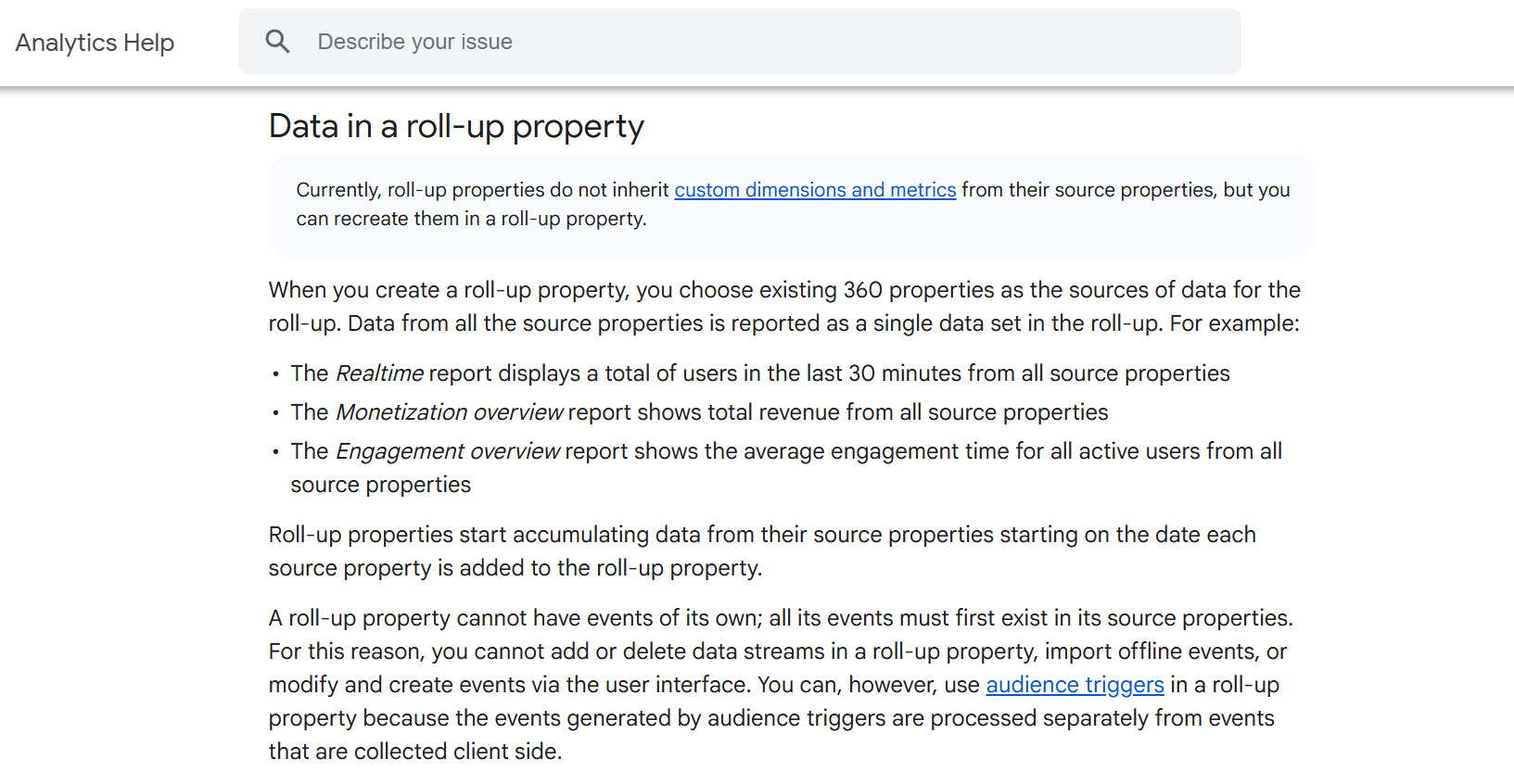
- Use Roll-up Properties in GA4. This feature allows you to combine data from multiple sites into a single, aggregated view.
- Leverage Looker Studio (formerly Data Studio). Build dashboards that pull data from multiple GSC properties and GA4 streams into one comprehensive report.
- Maintain a Master Tracking Sheet. A simple spreadsheet where you log key monthly metrics (traffic, visibility, top queries) for each subdomain and the main domain allows for easy trend spotting and comparison.
- Utilize Professional SEO Platforms. Tools like Semrush and Ahrefs let you add multiple domains and subdomains to a single project, tracking all their vital metrics side-by-side.
Key Metrics to Monitor for Subdomain Success

To gauge whether your subdomain SEO strategy is effective, you must track the right metrics consistently. They tell the real story – growth, stagnation, or trouble.
Pages Indexed
Check this in each subdomain’s individual Google Search Console. It’s your baseline: is Google seeing your content?
- What to watch: A sudden, significant drop is a major red flag. It can signal crawl issues (bad robots.txt, broken links), manual actions, or thin/duplicate content problems.
- Frequency: Check daily in the first few weeks after launch, then weekly or bi-weekly.
- Goal: Steady, incremental growth in indexed pages that matches your publishing cadence. Avoid sharp declines.
Organic Traffic
Your primary success metric. In GA4, use hostname filtering or separate data streams to isolate traffic for brand.com versus blog.brand.com, etc.
- What to watch: Look beyond total numbers to the trend. Is traffic to each subdomain growing after content launches and link-building efforts? What’s each property’s share of total brand traffic? Compare engagement metrics (avg. session duration, pages/session) across properties.
- Frequency: Review weekly for trends, analyze deeply monthly.
- Goal: Sustainable organic traffic growth for each subdomain. Stagnation indicates a need to rethink the strategy for that property.
Distribution of Target Queries
This metric directly addresses the risk of keyword cannibalization. You need clarity on which property ranks for what.
- What to watch: In the “Search results” report in each GSC property, monitor for high-value keywords that appear for both the main domain and a subdomain. Also, verify the subdomain is ranking for the thematic clusters you assigned to it.
- Frequency: At least monthly.
- Goal: Clear thematic separation. The main domain should own commercial/branded intent. Subdomains should capture informational, expert-level, and niche thematic queries. Overlap should be minimal and intentional.
Additional Important Metrics
Also keep an eye on:
- Backlink Profile Growth. In tools like Ahrefs or Semrush, track the increase in quantity and quality of unique referring domains pointing to each subdomain. Stagnant Domain Rating (DR) or Authority scores mean your link-building for that property isn’t working.
- Conversions & Goals. Set up GA4 goals for key actions on each subdomain (e.g., newsletter signups on the blog, contact form submissions on the support site). Traffic without conversions points to irrelevant content or poor UX.
- Core Web Vitals. Each subdomain is judged independently for page experience. Poor LCP, FID, or CLS on one subdomain will hurt its rankings, even if your main site scores perfectly.
Systematic monitoring turns guesswork into insight. You’ll instantly spot if a subdomain is cannibalizing the main site’s rankings, if its content isn’t being indexed, or if your efforts aren’t translating into valuable traffic.
Final Recommendations: Your Action Plan

Let’s cut to the chase. Here’s your practical takeaway.
Subdomain vs Subfolder: The Final Verdict
For most businesses whose primary goal is to strengthen their core website: choose a subdirectory (subfolder).
It’s the most straightforward and low-risk path. You concentrate all your authority, content, and user engagement in one powerful asset. Management is simpler, and analytics are unified.
A subdomain is a specialized tool. It’s for specific, often complex scenarios and demands more budget, time, and expertise to manage effectively.
The Golden Rule
Only use a subdomain if it solves a clear business problem that a subfolder can’t.
You’re not choosing it for an “SEO hack,” but for a strategic business reason. The accompanying SEO complexity is the accepted cost of that business decision.
- Subdomains help when launching a truly distinct service (app.site.com), a fully independent country-specific site, or a major new vertical on a different technology stack.
- Subdomains hurt when created based on SEO myths without a solid business rationale. You inherit all the downsides – fragmentation, duplicated effort, self-competition – for no tangible gain.
Managing a network of subdomains is advanced SEO. This is where in-house teams often get overwhelmed.
This is where LinkBuilder.com adds tangible value. We architect and execute strategies for complex, multi-domain ecosystems. We help you sidestep pitfalls, unify your analytics, and ensure each subdomain contributes positively – transforming them from liabilities into assets.
If you’re planning a subdomain or struggling with an existing one, get in touch with LinkBuilder.com. Let’s make all your sites work together as one cohesive force.