 Linkbuilding
 Guest Posting
 Niche edits
 Profil-Backlinks
 Crowd-Links
 Submission-Links
 Kontextuelle Backlinks
 White-Label Linkbuilding
 PBN Building
 Haro Links
 Digitale PR
 SEO
SEO
 SEO-Texterstellung
 Google-Indexierung
 Quora Links
 Eintragen in Business-Verzeichnisse
 AI SEO
 Reddit

You know how some people land on a website, read one article, and just buy right away? Then there are others who'll stick around for months, reading everything they can find, before they finally pull the trigger. That's not luck. That's a sales funnel doing its job.
Once you really understand how the funnel works, everything clicks into place for your SEO. When you know exactly where someone is in their journey, you can hand them the content they actually need at that moment. And suddenly, search engines start sending you people who are ready to buy, not just curious readers.
Let's walk through how the funnel works and break down what is TOFU-MOFU-BOFU and how to actually the funnel to drive sales.
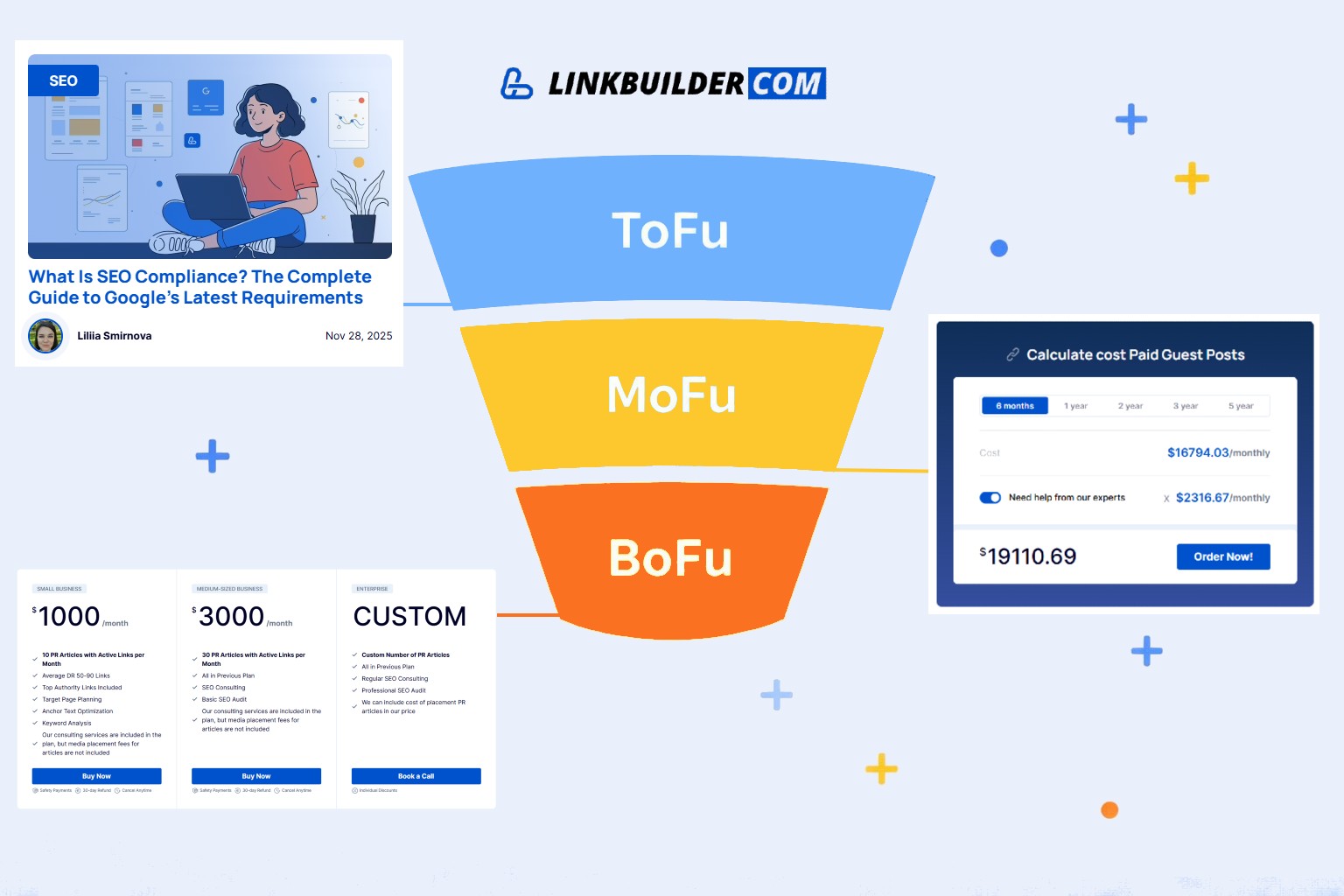
What Are TOFU, MOFU, and BOFU? Breaking Down the SEO Sales Funnel

Think about walking into a grocery store for bread, spotting a cheese sample, trying it, and tossing it in your cart. Simple, right? Online, it's a whole different story. Your customer can't see the product, can't touch it, can't check it out in person. They have to trust you. And trust doesn't happen in a single click.
The SEO content funnel is basically the trail a user leaves from their very first Google search to the moment they hit "buy." That journey breaks down into three big chunks, and each one needs its own game plan – different keywords, different content, different goals.
Where AIDA Came From and How It Morphs for Search
Back in the late 1800s, someone came up with the AIDA model, and honestly? It's still the backbone of pretty much every marketing strategy out there. Attention, Interest, Desire, Action.
It used to live in newspapers and on billboards. These days, it's all about search results. Someone types something in, spots your site (Attention). They click through, start reading (Interest). They're comparing prices, digging into case studies (Desire). And finally, they buy or fill out a form (Action).
For SEO, this idea evolved into TOFU, MOFU, and BOFU. The cool part? Online, you can actually track someone's path just by looking at the words they're searching for. That's why TOFU MOFU BOFU content marketing isn't just academic – it's something you can use every day.
TOFU (Top of the Funnel): Getting People in the Door
TOFU is the wide top of the funnel. This is where people show up with a question or a problem. They have no clue who you are or what you sell. They're just trying to figure stuff out.
At this point, they're hunting for general info. Think searches like "how to start running in the morning," "what is link building," or "picking a laptop for work." Cold traffic, basically.
Your only job at TOFU is to grab their attention. Try to sell them something right now, and they'll bounce straight to a competitor who actually answers their question.
MOFU (Middle of the Funnel): Getting Them Hooked
MOFU is the middle ground. These people get what their problem is, and now they're poking around for solutions. But they haven't picked one yet.
They're reading reviews, weighing options, digging into case studies. Their searches get more specific: "best home treadmills," "WordPress hosting compared," "which coffee machine for an office."
This is warm traffic. These folks are potential customers. They know they need to spend money – they're just deciding who gets it. In your TOFU MOFU BOFU content strategy, this is where you build trust and show them you actually know your stuff.
BOFU (Bottom of the Funnel): Closing the Deal
BOFU is the narrow end of the funnel, and honestly? These are the people you want. They've made up their minds – they know what product type they want, they've got a budget. Now they just need a place to buy.
They're typing in stuff like: "buy iPhone 15 Berlin," "order pizza delivery," "AC installation cost Munich." No time for articles. They want the price, delivery details, and a buy button.
This is hot traffic. Conversion rates go through the roof here. If you've set up your lead generation SEO funnel the right way, someone coming in on one of these queries is almost ready to hand over their money. Your job? Get out of their way and give them exactly what they need to decide fast.
Finding the Right Keywords for Each Funnel Stage

The stuff people type into Google is basically a script of what they're about to do. The search engine instantly knows if they're buying, comparing, or just browsing.
Try pushing a commercial page with an informational query, and you'll get nowhere. Google isn't going to rank an online store #1 for "how to pick a bike." That spot belongs to blogs and guides.
So yeah, you've got to gather TOFU keywords SEO, MOFU keywords SEO, and BOFU keywords SEO separately. And you need a different page format for each type. Otherwise, you're just burning cash on stuff that'll never sell.
TOFU Informational Queries: Casting a Wide Net
Informational queries are questions, plain and simple. People want answers. They want to learn something. They're not buying right now. Honestly, don't even put a "Buy" button on these pages.
What do these look like?
- "how to set up Facebook targeting"
- "what are crowd links"
- "why is my hair falling out"
- "2026 electric cars review"
- "gift ideas for husband"
You'll spot markers like "how," "what is," "why," "guide," "tips," "review," "rating."
Your mission at this stage? Bring in as many people as possible who care about your topic. Make them remember you as the expert. And most importantly, hook them so they want to keep going – maybe they subscribe to your newsletter or click through to another article.
TOFU MOFU BOFU guide level content is all about being useful. Keep the ads light, the help heavy.
MOFU Commercial Queries: Snagging the "Warm" Leads
Once someone's using MOFU queries, they've done the basic research. Now they're picking a seller or a specific model. This is where the competition gets fierce. People are comparing everything, nitpicking details.
Commercial queries sound like:
- "iphone or samsung which is better"
- "Warsaw dentist reviews"
- "best crowd marketing platforms"
- "ecommerce hosting comparison"
- "small business CRM systems rated"
Navigational queries live here too – people searching for a specific brand or store but not quite buying yet: "H&M catalog," "Nike men's shoes."
These users are "warm." They know what they want. They just need their last doubts cleared up.
This is your moment to show why you're better than everyone else. Comparison pages, catalogs with filters, detailed reviews – that's what works here.
BOFU Transactional Queries: Sealing the Deal
Transactional queries are pure commerce. The intent to buy, order, or pay is baked right in. No need for long sales pitches. Just make it easy to act.
Examples:
- "buy iPhone 15 pro max delivery"
- "order crowd marketing"
- "install AC Munich cost"
- "Berlin to Prague flights"
- "Paris hotel 50% off"
The markers are dead simple: "buy," "price," "order," "delivery," "tickets," "discount," "cost," "sale."
Someone typing this stuff has already been through TOFU and MOFU. They know exactly what they need. On your site, they should see the price and the order button immediately.
SEO for sales funnel works best when transactional pages aren't buried in text. Short description, specs, price, order form. Done.
Intent Mapping: Keeping Your Funnel Stages Straight
The biggest mistake is pushing a commercial page with an informational query. Like writing "how to pick a laptop" and slapping a "buy" button under every heading. Or the reverse – trying to rank a blog post for "buy laptop."
Google gets smarter every year. The algorithms are scary good at figuring out user intent. If your page doesn't match what someone's actually looking for, all the links in the world won't get you to the top.
Want to keep your stages straight? Check the search results. Type in your keyword and see who's ranking. Blogs and articles? That's TOFU. Online stores and catalogs? That's MOFU or BOFU. Do what the search engine does: copy what's already working.
Build your SEO funnel strategy the right way: blogs for informational queries, category pages for commercial ones, product pages with prices and buy buttons for transactional. Then every visitor lands on exactly the page they need.
Building a TOFU MOFU BOFU Content Strategy: What to Write and When
So you've got your keywords sorted. Now what do you actually write for each stage? Churning out a hundred articles isn't enough. If the content doesn't solve someone's problem, it's useless.
People read differently depending on where they are. Some scan headlines for quick answers. Others dig into every spec. Some just want the damn buy button.
That's why using TOFU MOFU BOFU in SEO for content means three totally different approaches. You can't write the same way for beginners and for people ready to spend.
How Content Changes Across TOFU, MOFU, BOFU: 3 Flavors for 3 Goals
Picture this: you're selling Spanish courses.
- Someone just thinking about learning types "how to learn Spanish alone." They want tips, motivation, hacks.
- Someone who's decided to learn searches "best Spanish schools." They need facts, comparisons, proof.
- Someone ready to sign up types "book Spanish course." They want a payment form.
Massive difference, right? Mix all that together and you'll satisfy nobody.
The content marketing funnel lives and dies by keeping formats separate. Here's the breakdown:
| Funnel Stage | What You’re Trying to Do | Best Formats | How You Sound |
|---|---|---|---|
| TOFU | Grab attention, teach, get them curious | Blog posts, guides, checklists, infographics, podcasts | Friendly, easygoing, no pressure |
| MOFU | Convince them, squash doubts, prove you know your stuff | Case studies, webinars, comparisons, category pages, landing pages | Expert, detailed, making your case |
| BOFU | Close the sale, clear the path | Product pages, prices, deals, reviews, guarantees | Straight to the point, CTA in your face |
These formats don't swap around. You can't wrap a transaction inside a guide. Let's dig into each one so you see how it actually works.
Writing TOFU Content: Blogs, Guides, Stuff People Want to Share
Top of the funnel is all about reach. You're not selling – you're building an audience. Your goal? Get someone to hang out on your site for five minutes, read a thing or two, and maybe subscribe.
The best TOFU stuff is meaty guides, life hacks, industry news. People eat up lists: "10 ways," "5 reasons," "7 mistakes." Easy to read, easy to share.
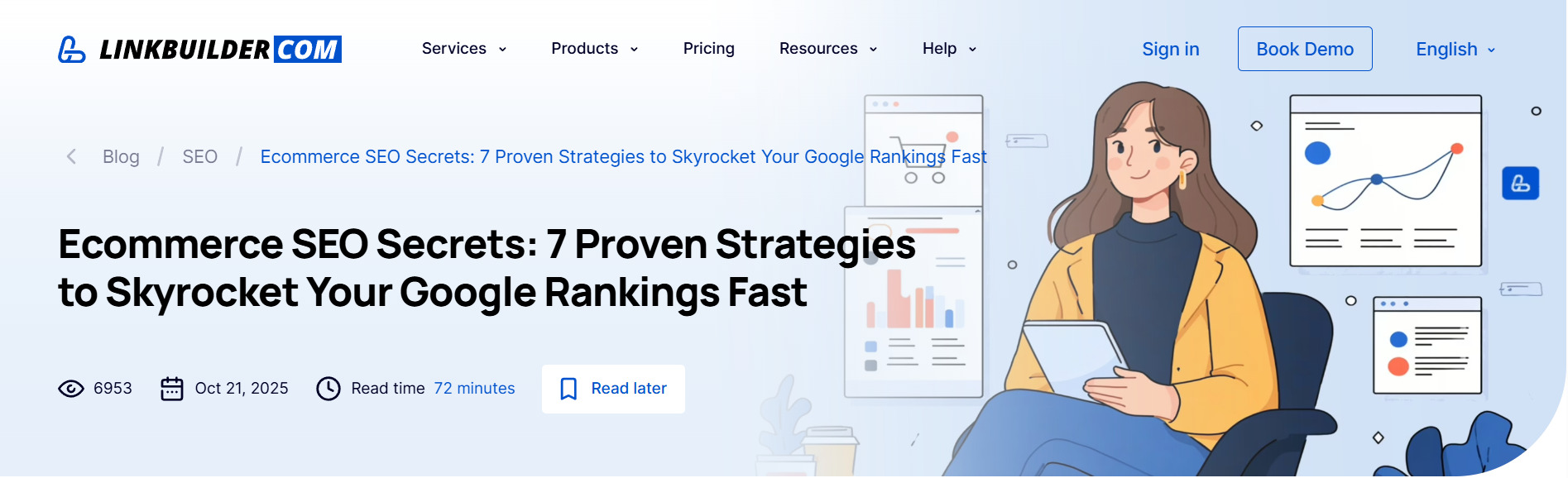
Check out our post "Ecommerce SEO Secrets: 7 Proven Strategies to Skyrocket Your Google Rankings Fast."
Don't be scared to give away good stuff for free. The more value you drop upfront, the more likely they'll remember you. When they're finally ready to buy, they'll come back.
In TOFU MOFU BOFU examples of content done right, the top level works like a magnet. Good content pulls in backlinks, gets quoted, gets shared. Great for link building too.
Writing MOFU Content: Case Studies, Webinars, Category Pages
At MOFU, nobody wants "what is" anymore. They want to know which product fits them and why. You need receipts. Proof.
Case studies crush it here. Show how your product or service fixed a real person's problem. Numbers, facts, before-and-after. Kills fears and objections cold.
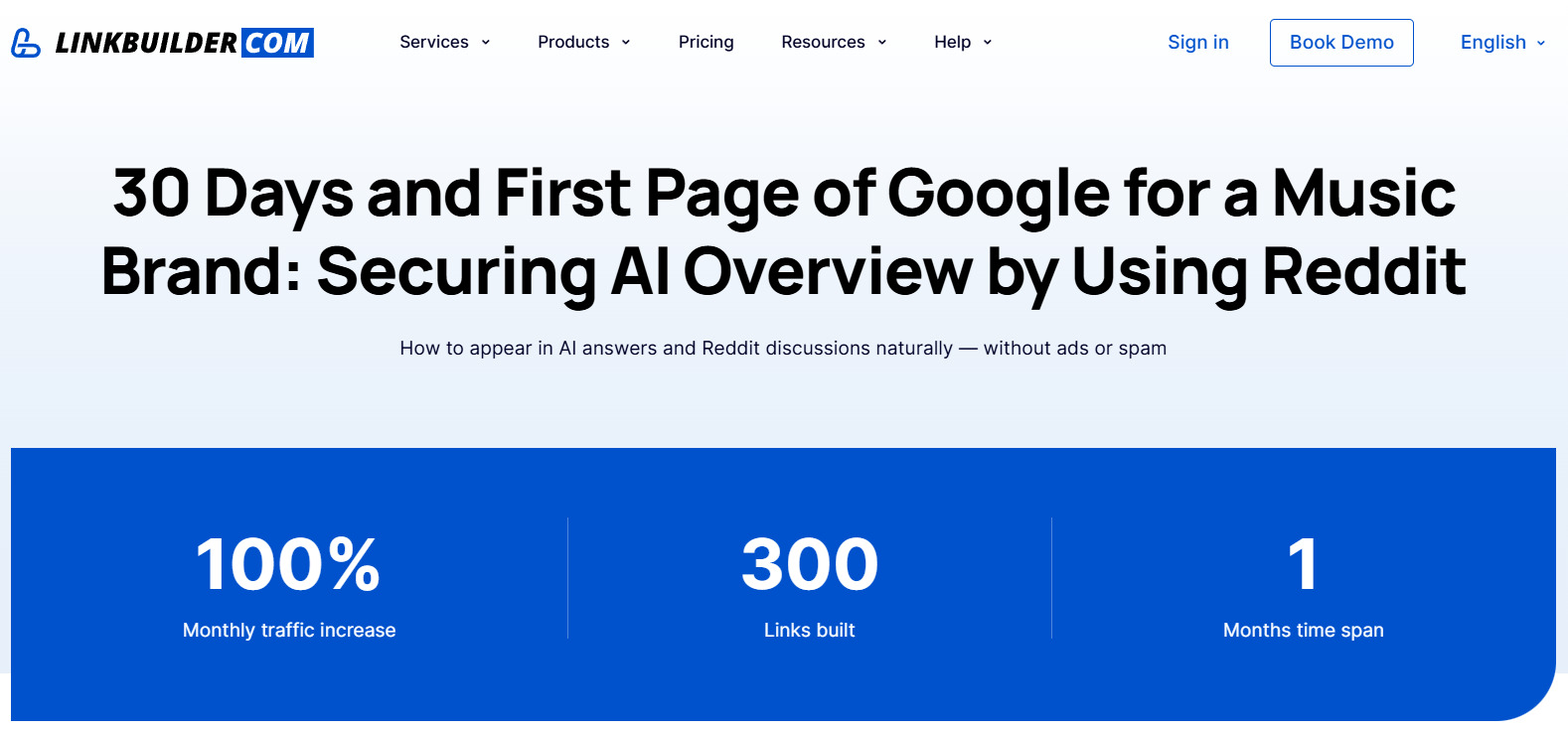
Look at one of ours: "30 Days and First Page of Google for a Music Brand: Securing AI Overview by Using Reddit."
Category pages live here too. "Men's running shoes" isn't a transaction – it's a choice. Someone's browsing models, comparing prices, checking specs. Make it easy to filter, sort, and dig in.
Webinars and masterclasses? Also huge. Real-time interaction builds trust like nothing else. People often buy during or right after a good one.
Comparisons – "us vs. them" – work wonders. Someone's picked a category but can't decide between two models. Show them honestly why yours wins (cheaper, better, more reliable), and you tip the scales.
Interactive content kills it at MOFU too. Free tools, calculators, quizzes pull people in deeper than plain text ever could. Like LinkBuilder.com's Media Outreach Cost Planner – someone plugs in their numbers, gets a custom estimate.
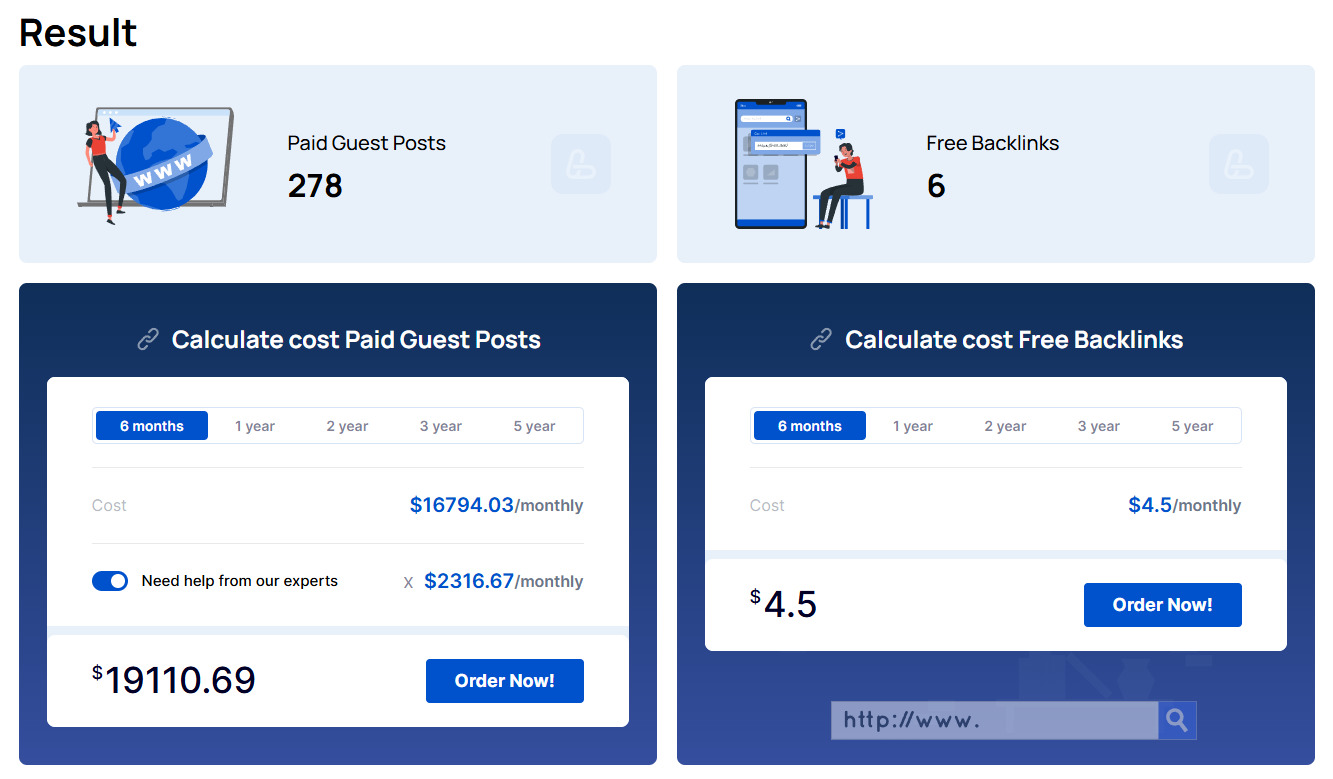
It's not just a gimmick. It shows you know what you're doing, keeps them on your site, and nudges them toward working with you. Interactive stuff grabs people who are already shopping around and pulls them closer to a yes.
The whole point of the conversion funnel SEO at this stage? Give them enough to make a smart choice. If you don't convince them, someone else will.
Writing BOFU Content: Product Pages, Prices, Make It Easy
Bottom of the funnel is all about specifics. No fluff.
The product page is your BOFU workhorse. It needs: a clear price, solid photos, specs, stock status, and an order button. Save the long essays about why your product's great – they read that stuff already.
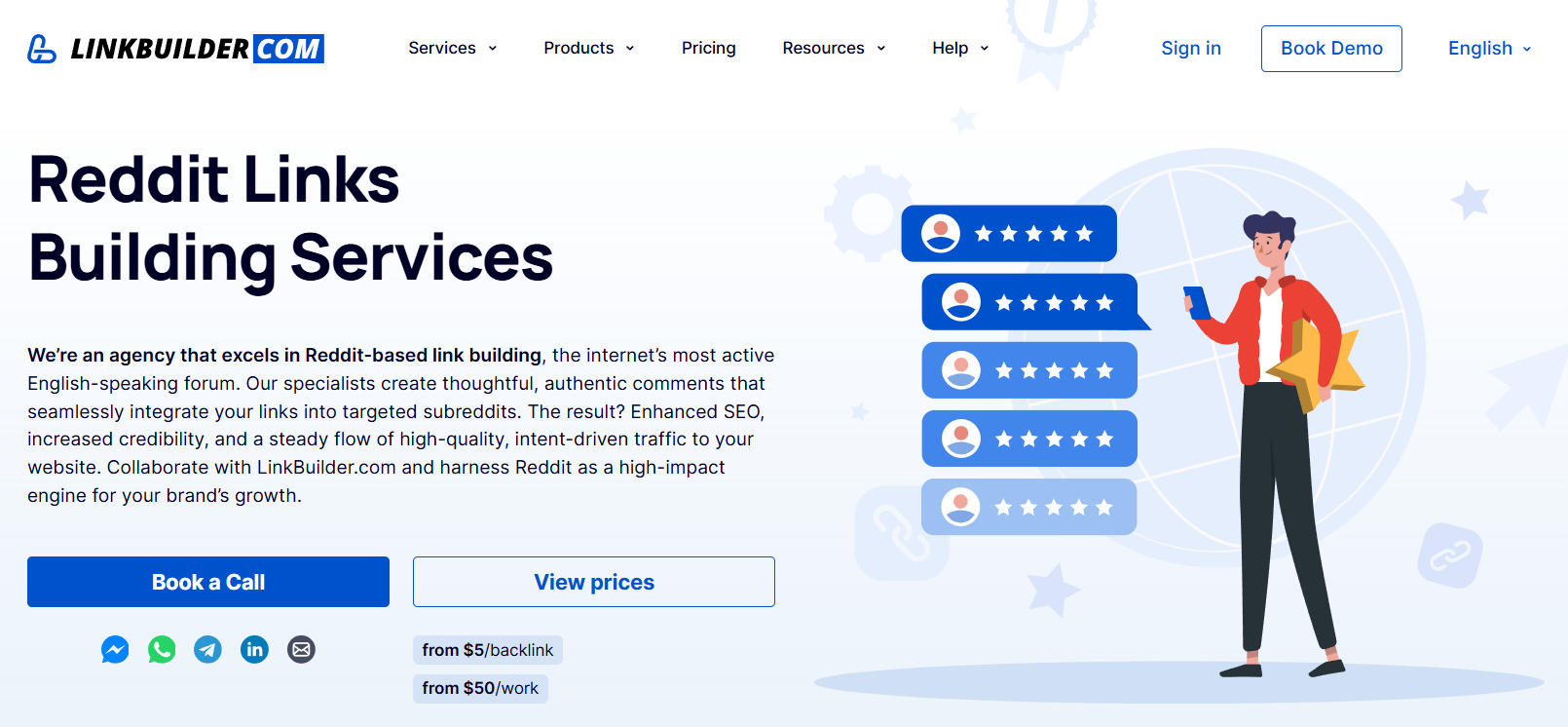
Check out our Reddit link building page – demo booking, prices, right there.
Real customer reviews? That's BOFU gold. People trust other people way more than they trust ads. Video reviews? Even better.
Lead generation SEO funnel at the bottom is simple: someone lands, sees the price and terms, fills out the form. No extra clicks, no distractions. Just straight to the point.
When your TOFU MOFU BOFU content strategy flows right, someone glides from a blog post to placing an order without even feeling pushed. They decide on their own, because you handed them exactly what they needed, exactly when they needed it.
SEO for the Sales Funnel: The Technical Stuff That Matters
Writing killer content for each funnel stage is only half the battle. You've got to package it right. Without the technical foundation, even your best stuff never sees the top of search results.
Search engines aren't just reading your words. They're looking at site structure, how pages connect, and those little code hints you leave. Skip this, and competitors with worse content but better tech will smoke you.
TOFU MOFU BOFU in SEO isn't just keyword homework. It's about building your site so search engines get what each page does, and users wander straight through to a purchase.
Using TOFU, MOFU, BOFU for Internal Links That Actually Help
Internal linking is just connecting your pages with links. Simple, right?
The formula: informational posts (TOFU) link to commercial categories (MOFU). Categories link to specific products or services (BOFU). And you need links going back up too – from bottom to top.
Here's a real example. Say you sell bikes online. You write "how to pick a city bike" (TOFU). Inside, you drop links to your "city bikes" category (MOFU) and your best-selling models (BOFU). That's exactly what Polygon Bikes does in their guide "City Bike Buying Guide: Understanding Urban Bikes & Choosing the Right One."
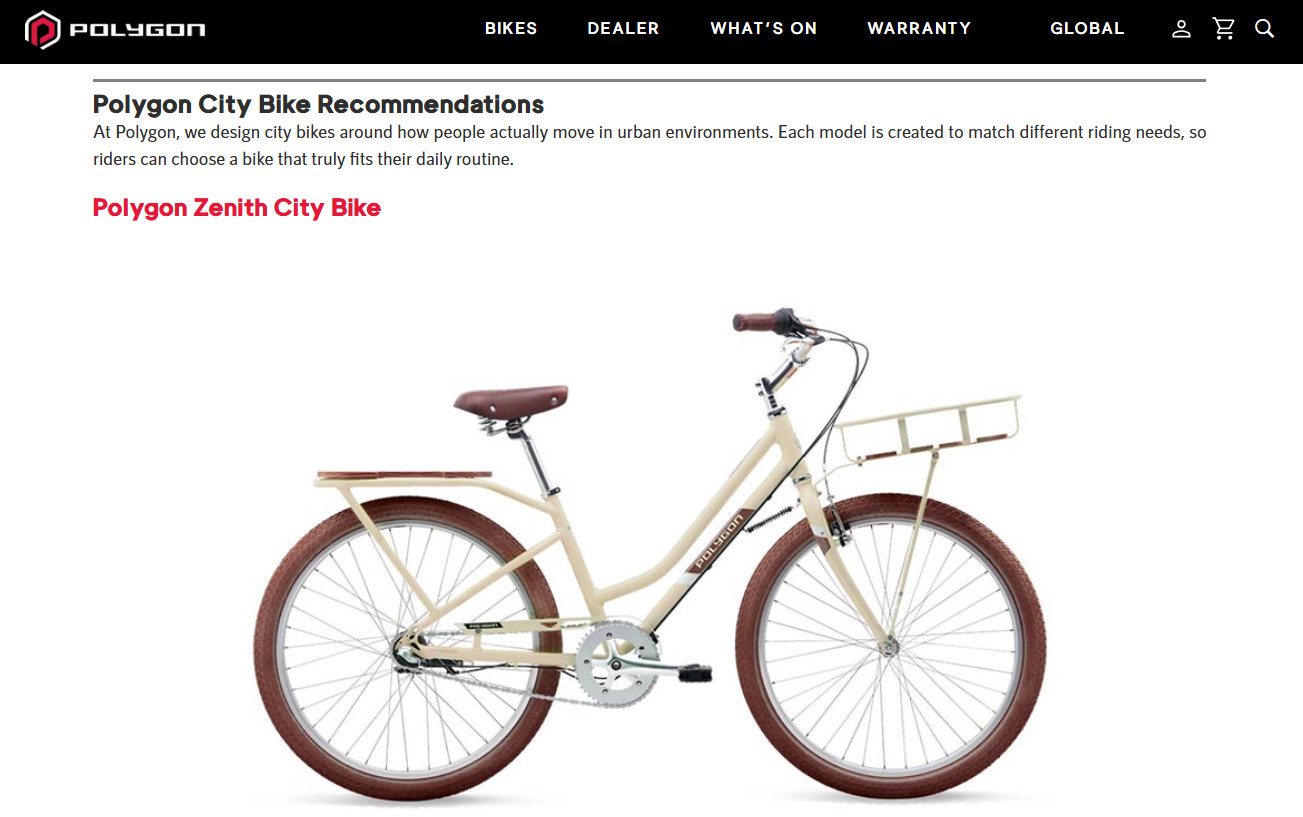
Your category page links to top models. And on each product page, you've got a "useful articles" section linking back to the blog.
This setup does two things. First, users never get lost – they can always move forward or back in the funnel. Second, page authority flows the right way. Search engines see your blog backing up your commercial sections and boost their rankings.
When you're building your SEO funnel strategy, keep your links relevant. Don't link to kitchen knives from a bike article. Nobody clicks that, and search engines hate it.
Microdata and Snippets: Playing Nice With Each Funnel Stage
Microdata is code that tells search engines exactly what's on your page. That's how you get those fancy snippets with pictures, star ratings, and prices in search results.
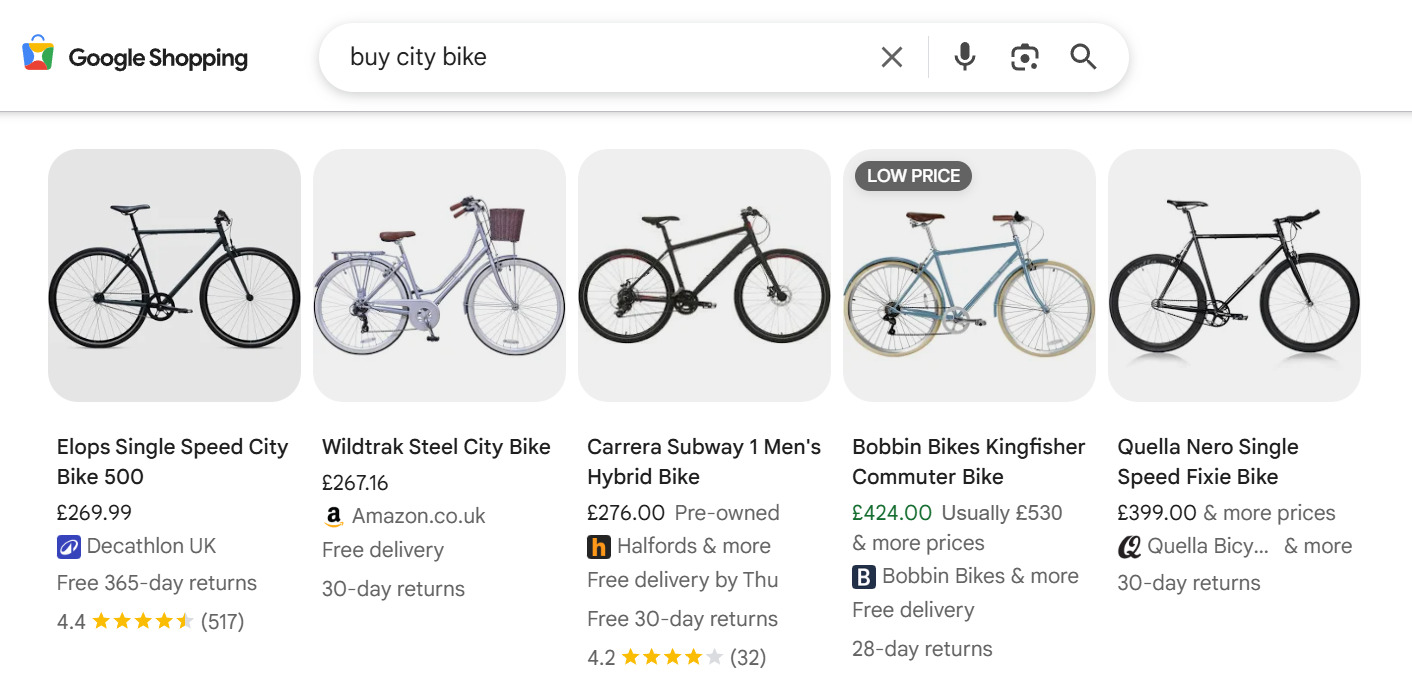
Each funnel stage needs its own markup. Mess it up, and search engines get confused.
- For TOFU, FAQPage or Article markup kills it. Questions with answers right in the search results? People click that. When someone's hunting for info, seeing answers already in the snippet makes them pick you.
- At MOFU, HowTo and Review markup shine. Got a product comparison or buying guide? Tag it. Makes you look way more authoritative in results.
- For BOFU, you absolutely need Product markup – price, stock, reviews, the works.
When people spot prices and ratings right in search results, click-through rates explode. They know they're landing on exactly what they need, not some generic page.
Building Page Authority With Outside Links
Content and internal links are just the start. Without external links, good luck ranking in competitive spaces.
Why do they matter? Search engines treat links from other sites like votes of confidence. More quality votes, higher you rank.
Different funnel levels need different link strategies. TOFU content – useful posts, guides, research – gets shared naturally. Bloggers link to it, journalists cite it. That's how it should work, if your stuff's actually good.
Commercial pages are harder. Product pages and categories don't get as many natural links. That's fine. But these are your money pages. They need help.
Enter professional link building. You've got to find spots where a link looks natural and actually brings traffic.

Finding donors yourself is a grind. Checking dozens of sites, negotiating, watching for quality. Way easier to hand it to people who do link building for a living.
Hit up LinkBuilder.com to boost your funnel pages with external links and climb those rankings.
We match donors to your stage:
- For TOFU (info posts), we find donors that bring relevant traffic and make search engines trust your content more.
- Need MOFU (commercial pages) to rise? We'll grab links from relevant forums and blogs.
- For BOFU (product pages), we pick spots with real clicks. Not just "for show" – actual traffic and ranking gains.
Every link gets checked by hand: site traffic, domain history, no penalties, relevant to you. Only links like that actually pay off. Contact us, and we'll figure out how to help where you are now.
Measuring What Matters: Lead Generation Through Your SEO Funnel

Throwing content out there and crossing your fingers? Terrible plan. Without numbers, you'll never know what's working and what's burning cash.
Lead generation SEO funnel comes down to knowing: how many showed up, how many got interested, how many almost bought, how many actually did. If you're losing people at any point, you know exactly where to dig.
TOFU Metrics: Traffic and Getting Them to Stick
At the top, it's all about who shows up and whether they stick around. Too little traffic? Wrong topics or keywords. Traffic but everyone bounces? Content's not delivering what they expected.
What to watch at TOFU:
- Search traffic. The basics.
- Rankings for info queries. Are your posts climbing?
- Bounce rate. Over 70-80% for articles? Something's broken.
- Time on page and pages per session. Are they actually reading? Clicking through?
- Social shares and backlinks. Is anyone sharing or linking to this?
Good TOFU looks like: people show up, read, browse around. They might not buy or sign up right away. That's fine. But they should do something – finish the post, click a link inside, subscribe.
Judge TOFU content by engagement, not sales. If a post's still pulling traffic and getting links six months later? You nailed it.
MOFU Metrics: Lead Quality and the Little Wins
Middle of the funnel is where people start getting serious. They're not just reading – they're interacting. Here we watch intent, not just numbers.
MOFU metrics that matter:
- Leads from landing pages. How many dropped an email, grabbed a checklist, signed up for a webinar?
- CTR in search for commercial queries. Are people clicking your pages in results?
- Pages per session. Are they checking out multiple products or services?
- Return visits. Coming back to compare or dig deeper?
- Lead quality. How many of those contacts actually bought later?
At this stage, set up goals in your analytics. Track file downloads, clicks on "request a call" inside categories, views of contact info. Not final sales yet, but loud signals of interest.
SEO for sales funnel at MOFU works like this: if people reach this stage but don't do those small actions, your content's not convincing. Back to the drawing board.
BOFU Metrics: ROI and the Real Action
Bottom of the funnel is where the money lives. Simple: they bought or they didn't. Your SEO spend paid off or it didn't.
BOFU numbers to watch:
- Transactions/requests. Direct sales from commercial pages.
- Page conversion rate. % of product page visitors who ordered.
- Revenue from search traffic. What specific keywords and pages brought in.
- Average order value. Are search buyers spending as much as others?
- ROI. (revenue – SEO costs) / SEO costs * 100%.
If your BOFU pages rank, traffic's flowing, but nobody's buying? Problem's in usability, price, or trust. Button hidden? Delivery too expensive? Reviews bad? Find it, fix it.
Connecting the Dots: SEO and Conversions Across TOFU, MOFU, BOFU
Hardest part is tracing a sale back to where it really started. Someone might've found you six months ago through a blog post, then came back later on a brand search and bought. Count only the last click, and your blog gets zero credit – even though it did the heavy lifting.
Cross-channel analytics stitches all those touches together into one story. You see: came from a post → visited a category a week later → came back and bought a month after that.
How to set it up. Use a CRM hooked into your analytics. Tag every piece of content with UTM parameters. TOFU posts get their own tags, MOFU pages theirs, BOFU pages theirs.
Then you'll know exactly which posts actually drive sales and which just bring in looky-loos. Might turn out your best money comes from some random MOFU comparison, not your product pages.
How to use TOFU MOFU BOFU in reports? Don't just report by channel. Report by where people are in their journey. Show your boss more than "SEO brought 1000 people." Show them "SEO brought 1000 people to the top, 100 made it to the bottom, and 20 bought stuff worth 5000 euros."
Common Screw-Ups When Running a Funnel in SEO

Funnel models look great on paper. In practice? Lots of sites trip up. Same mistakes, different niches.
Here are the three biggest. They're why SEO sometimes doesn't sell, even when traffic looks fine.
Skipping MOFU: Going Straight From Traffic to Sales
So many site owners think just getting someone to a product page equals a sale. But people need time to decide. Especially if it's expensive or complicated.
You push commercial pages with high-intent queries. People show up, spot the price, and bounce. They're not ready yet – still got questions. Is it reliable? Will it work for them? Any warranty?
They go find those answers somewhere else. If you didn't give them the info they needed to decide on your site, they're gone to a competitor.
MOFU exists to catch people between "hmm, interesting" and "take my money." Comparison pages, category overviews, use cases, parameter-based filters – all that helps them actually decide.
In B2B, real estate, medical stuff, complex tech? You literally can't sell without MOFU. Nobody drops big money on a whim. They need reasons. Proof.
Keyword Cannibalization: One Page Trying to Do Everything
Sometimes sites build one page to rule them all. Info for newbies, model comparisons, price and buy button all smushed together.
Search engines look at that and go… what even is this? What intent does it match? Someone hunting info wants articles. Someone hunting a store wants a product page.
Result? Page ranks for nothing. Loses to competitors who actually bothered to separate their content for different purposes.
Users hate it too. Info-seekers get hit with sales pitches. Ready-to-buy folks have to dig through essays to find the price and button.
Each funnel stage needs its own page. Informational posts shouldn't compete with commercial sections. Different jobs, different structures.
TOFU With No Next Step: Traffic Shows Up, Then Vanishes
Sites spend real money on useful content. Posts rank, pull in traffic. People read, hang out, then leave and never come back.
What went wrong? No next step. Someone got their question answered, but they've got no clue where they were. No reason to stay or come back.
At TOFU, you're not selling. But you should be offering something to keep the conversation going. Download a checklist. Subscribe to the newsletter. Read a related post. Watch a video on the topic.
Get their contact info, and you can reach them later. Get them to another page, and they're digging deeper. Either way, you don't lose them.
Posts without calls to action are just burning money. Traffic flows, value's there, but no contacts, no leads. Terrible ROI on your content spend.
Wrapping Up: TOFU MOFU BOFU Content Marketing for Sales You Can Actually Predict
We've covered a lot. Here's what actually matters:
- The SEO funnel has three stages. TOFU pulls people in with info queries. MOFU works the folks who are shopping around. BOFU closes deals with transactional queries. Each needs its own playbook.
- Keywords need sorting by stage. Info queries have "how," "what is," "why." Commercial ones have "reviews," "rating," "comparison," "where to buy." Transactional ones have "price," "order," "delivery," "buy." Smush them together on one page? Wasted effort.
- Content has to match what people actually want. TOFU wants articles, guides, checklists. MOFU wants case studies, category pages, webinars, comparisons. BOFU wants product pages with prices, delivery info, and order buttons.
- Internal links guide people through. Info posts link to commercial categories. Categories link to specific products. Products link back to useful posts. Better navigation, better authority flow.
- Microdata boosts click-through rates. FAQPage and Article for TOFU. HowTo and Review for MOFU. Product with price and stock for BOFU. Helps search engines show off your pages.
- Different metrics for different stages. TOFU: traffic, time on site, bounce rate. MOFU: micro-conversions, lead quality, return visits. BOFU: transactions, conversion rate, revenue, ROI.
- External links matter for every stage. Info content gets links naturally. Commercial pages need targeted link building. Without outside links, ranking is a nightmare.
Working your content marketing through the funnel makes sales way more predictable. You see exactly how many people are where, and where you're losing them. Fix those spots, and your whole SEO machine runs better.
Need help pushing pages at any funnel stage? Hit up LinkBuilder.com. We find proven spots that deliver real traffic and better rankings. For every funnel stage, we dig up donors that make your stuff beat the competition and bring in steady sales.